.png)

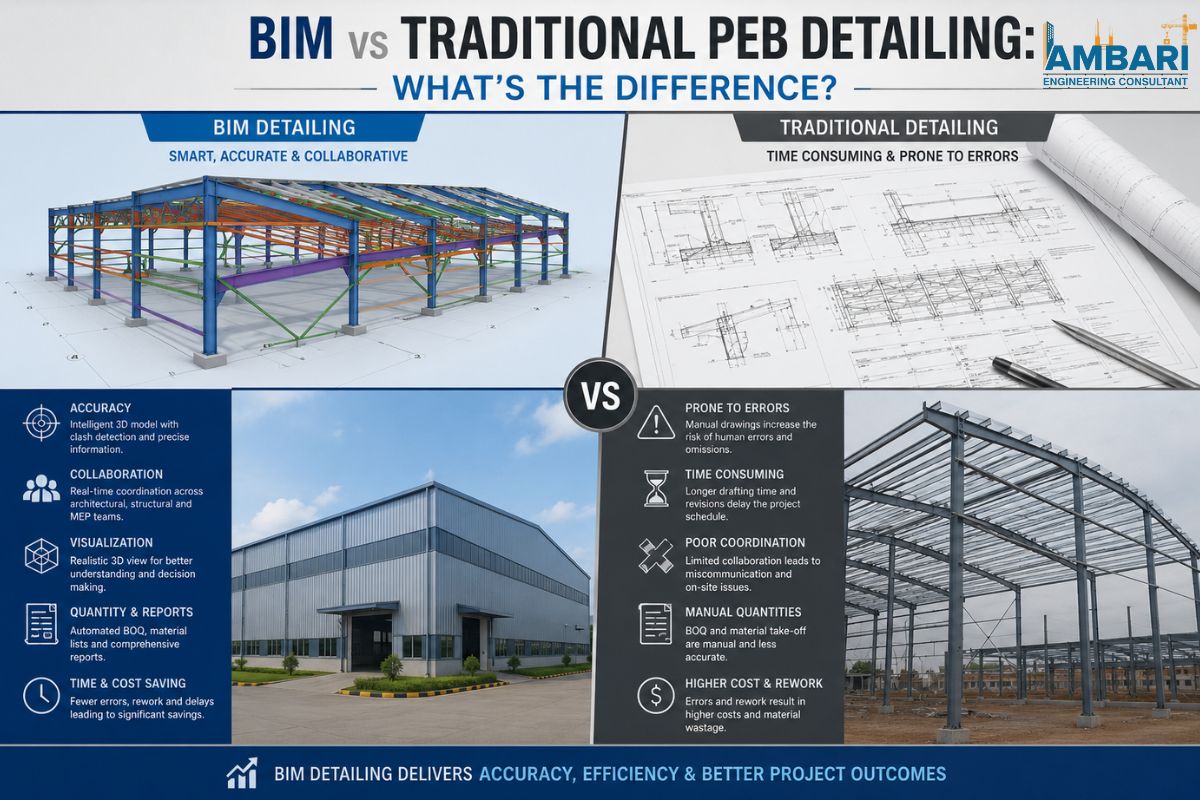
The benefits of BIM include improved coordination, faster workflows, and fewer errors compared to traditional detailing. Therefore, for complex steel construction projects that require higher accuracy and better project control, BIM is preferred by modern industries and companies such as Ambari Consultant.
BIM stands for Building Information Modeling. It is a digital solution that allows engineers, architects, and fabricators to collaborate within a single integrated model.
Unlike traditional drawing-based methods, BIM creates a comprehensive 3D model that includes dimensions, joints, material information, and clash detection.
In many projects, BIM helps teams visualize the complete structure even before fabrication begins. As a result, errors can be identified at an early stage instead of during installation.
Major advantages include:
Today, many firms providing PEB design and detailing services are shifting toward BIM because industrial projects require greater accuracy and faster execution timelines.
Communication is also one of the biggest advantages of BIM. The 3D visualization of all structural components helps site engineers and fabricators understand the project more clearly compared to traditional 2D drawings.
Traditional detailing mainly relies on 2D CAD drawings. In this approach, detailers prepare fabrication drawings, connection details, and layouts separately.
This method has been effective for many years, but it requires more manual checking and coordination.
For smaller buildings, warehouses, or simple factory sheds, traditional detailing can still be useful because the structure is less complex. However, manual coordination becomes more difficult in larger projects.
Common challenges in traditional detailing include:
Even so, experienced engineers can still achieve excellent results using traditional detailing methods. Many companies offering PEB detailing services continue to use CAD-based workflows for projects that do not require BIM.
However, BIM offers a clear advantage when multiple disciplines collaborate on a single project.
Speed and accuracy are major priorities in the construction industry. This is one of the key reasons BIM is being rapidly adopted in industrial and commercial projects.
One major advantage of BIM is clash detection. BIM software can identify clashes between structural elements before fabrication begins. This helps reduce material wastage and minimizes correction work at the site.
Additionally, BIM improves collaboration because the latest project information is shared with all stakeholders in real time, making communication much easier.
| Feature | BIM Detailing | Traditional Detailing |
|---|---|---|
| Visualization | 3D Model | 2D Drawings |
| Coordination | High | Moderate |
| Revision Handling | Faster | Manual |
| Error Detection | Early Stage | Often at Site |
| Project Speed | Faster | Slower |
Today, many industrial clients prefer BIM-driven PEB structure detailing because it supports faster fabrication and smoother erection work.
Furthermore, BIM also helps with project maintenance even after construction is completed.
Time is one of the most important factors in steel construction projects. Delays can increase labor costs, material handling expenses, and equipment rental charges.
Traditional detailing may become time-consuming during revisions because each drawing often requires manual correction. In BIM, however, connected views update automatically whenever changes are made to the model.
For example:
BIM reduces repetitive work and improves fabrication accuracy. Therefore, many companies involved in pre-engineered building design in India implement BIM for more organized project execution and faster results.
Steel detailing errors can create major construction issues. Incorrect dimensions, missing bolts, or connection clashes may delay site work significantly.
Traditional detailing depends heavily on manual checking. Although experienced detailers can reduce errors, the risk is still generally higher compared to BIM workflows.
BIM improves quality control through:
BIM identifies clashes before construction begins, helping engineers reduce delays and costly mistakes. As a result, many companies providing structural steel detailing services in India are adopting BIM for greater accuracy, stronger coordination, and clearer project presentation.
Initially, BIM may appear expensive because it requires specialized software and skilled professionals. However, over the long term, it often reduces overall project costs.
Fewer site errors lead to:
Traditional detailing may still be more affordable initially, especially for smaller projects. However, for large industrial structures, correction work caused by coordination issues can become very costly.
That is why companies such as Ambari Consultant recommend selecting the detailing method based on project complexity rather than only initial drafting costs. In most long-term industrial projects, BIM provides greater overall value.
Modern construction projects require greater accuracy, faster execution, and better coordination. Because of this, BIM is increasingly becoming the preferred choice for complex steel structures.
However, traditional detailing is still commonly used for simpler projects where budgets are smaller and coordination requirements are limited.
The following factors help determine the right approach:
For larger factories, warehouses, airports, and commercial buildings, BIM offers better control over the complete workflow and improves overall coordination.
On the other hand, smaller fabrication projects can still be completed successfully using traditional drafting methods.
Experienced engineering firms such as Ambari Consultant carefully evaluate project requirements before selecting the most suitable detailing method.
The detailing in steel construction is important both with BIM and without BIM. But BIM helps to enhance coordination, error reduction, and project speed. Many companies that provide PEB design and detailing services are now opting for BIM when it comes to complex industrial work that has a need for greater accuracy and efficiency.
BIM creates a 3D virtual model that improves planning, coordination, and accuracy in steel structure projects.
Yes, traditional detailing is still suitable for smaller projects with simpler structural requirements.
BIM improves accuracy, reduces errors, and helps complete projects faster through better coordination.