.png)

Ask a project manager what causes the most delays on a steel job, and you'll rarely hear "the steel itself." You'll hear about a beam that didn't fit, a connection that needed rework, or a bolt pattern that clashed with an embed nobody caught in time. Almost every one of those problems traces back to detailing.
Steel detailing is the step between structural engineering and actual fabrication. An engineer decides how big a beam needs to be and how it should connect to the column next to it. The detailer turns that decision into a shop drawing precise enough for a fabricator to cut, drill, and weld without guessing. If that drawing is off by even a quarter inch, or if a connection detail doesn't account for how two members actually meet in three-dimensional space, the mistake doesn't stay small. It gets fabricated, shipped, and then discovered on site, usually by a crew standing around a piece of steel that won't line up.
This is why structural steel detailing services USA firms exist as a distinct trade from structural engineering. Engineering answers "will this hold?" Detailed answers "can this actually be built?" Both questions matter, but only one of them determines whether the fabrication shop hits its schedule.
What happens inside a detailing drawing?
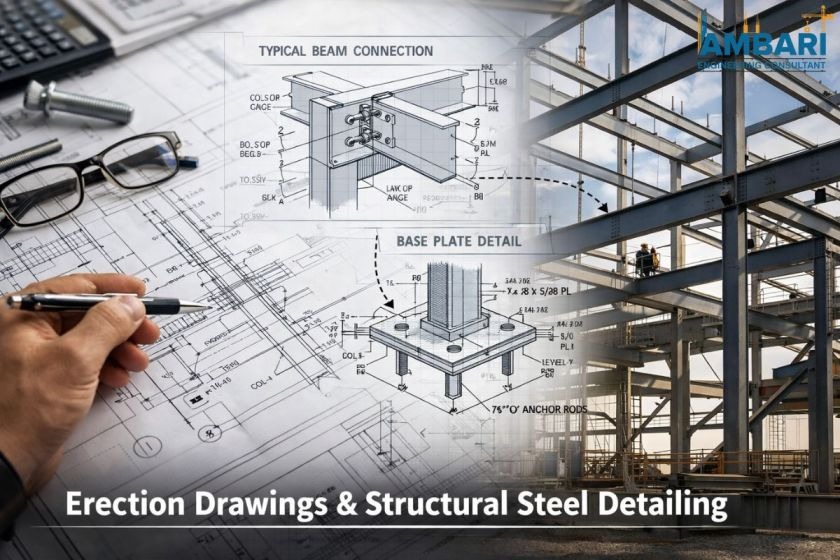
A detailing package usually includes two layers of drawings. Shop drawings tell the fabricator exactly how to build each piece: dimensions, hole locations, weld symbols, material grade, piece marks. Erection drawings tell the field crew where each piece goes and how it connects to the ones around it.
However, getting shop drawings right requires more than redrawing the engineer's design. A detailer has to think through clearances, bolt access, weld sequencing, and whether a connection can physically be assembled in the field with the tools a crew actually has. I've seen drawings that were dimensionally correct on paper but impossible to bolt together, because there wasn't enough clearance for a wrench to turn.
This is also where shop fabrication drawing services in the USA earn their keep. A fabricator working off a clean, buildable drawing can move a piece through cutting, drilling, and welding without stopping to call the detailer. A fabricator working off a drawing with unresolved conflicts has to stop, ask, wait, and often re-sequence the whole shop floor around one problem piece.
Connection details carry most of the risk
Member sizes rarely cause fabrication headaches. Connections do. A moment connection, a shear tab, a base plate with anchor bolts that don't match the foundation survey: these are where geometry gets complicated and where small oversights turn into field problems. Detailers who specialize in structural steel detailing services USA spend a disproportionate amount of their time here, because that's where the risk actually lives.
How do detailing errors actually show up on the shop floor?
It helps to walk through what actually happens when a detail is wrong, because the consequences aren't abstract.
A fabricator receives the shop drawing and cuts material based on the dimensions given. If a hole is placed a half-inch off, the piece still gets fabricated correctly according to the drawing. The error only surfaces during fit-up, or worse, during erection on site. At that point, the options are limited: field-drill a new hole, which weakens the member and often requires engineering sign-off; scrap the piece and refabricate it; or find a workaround that delays the schedule while everyone waits on a decision.
None of those options are cheap. Refabrication means new material, shop time, and shipping, on top of whatever schedule slot the piece already lost. Field fixes require an engineer to approve a deviation from the original design, which can take days depending on how busy that engineering firm is that week.
The real cost of inaccurate detailing has nothing to do with the drawing fee. It's everything that happens afterward, once the error is already cut into steel and nobody caught it in time.
The connection between detailing and fabrication speed
Fabrication shops run on predictability. A shop scheduling a week of production around a detailing package needs that package complete and coordinated before cutting starts. When drawings arrive with gaps, missing connection details, or unresolved RFIs, the shop either stalls or starts fabricating around the problem, which usually means fabricating the wrong thing.
Therefore, steel detailing services in the USA that understand shop workflows build drawings around how the shop will actually sequence production, not just whether the structural math checks out. They think about piece marking systems that make sense on a busy shop floor, about grouping similar connections so a shop can batch-process them, and about flagging long-lead items early so procurement isn't the bottleneck.
"I've worked with fabricators who could tell within the first few drawings whether a detailing package was going to run smoothly. It usually came down to whether the piece marks were logical, whether the bolt lists matched the drawings exactly, and whether connection details had already been checked against the actual steel sizes, rather than assumed sizes from an early design phase."
Why does coordination with the fabricator matter before finalizing?
The best detailing outcomes happen when the detailer talks to the fabricator before finalizing drawings, not after problems show up. A shop might have preferences for how a certain connection type gets fabricated, based on the equipment they have on hand. A detailer who ignores that and details purely to a generic standard can produce a drawing that's technically correct and still a pain to build.
Common mistakes that slow down steel projects
- Detailing from outdated design documents — Structural revisions happen throughout a project. Detailers working from a superseded engineering set end up producing drawings for a building that no longer exists on paper.
- Skipping connection design coordination — When connection design responsibility isn't clearly assigned between the engineer of record and the detailer, gaps appear. Someone assumes the other party checked something, and neither did.
- Underestimating tolerance stack-up — Individual pieces might each fall within tolerance on their own, but when several slightly-off pieces connect in sequence, the accumulated error can exceed what the connection was designed to absorb.
- Rushing the RFI process — When a detailer flags a question and the response takes a week, fabrication either waits or proceeds on an assumption. Neither outcome is risk-free.
- Treating detailing as a formality rather than a discipline — Some project teams still view detailing as a box to check before fabrication, instead of a technical step that determines whether fabrication goes smoothly. That mindset shows up in rushed timelines and thin quality checks.
What does good detailing look like in practice?
Good detailing is hard to notice, because when it works, nothing goes wrong. The fabricator doesn't call with questions. The erection crew doesn't find pieces that don't fit. The schedule holds.
A few things tend to separate strong detailing work from average work:
- Drawings are checked against what a specific fabricator's shop can actually do, not just against AISC standards on paper.
- Connection details are resolved before they reach the shop floor, not discovered during fabrication.
- Piece marking is consistent and logical across the entire package, so a shop can track hundreds of pieces without confusion.
- RFIs get answered fast enough that they don't turn into schedule bottlenecks.
- The detailer understands the difference between what's structurally sufficient and what's actually buildable given real-world tolerances and access.
Ambari Consultant has built its structural steel detailing services USA around that last point specifically: drawings that hold up under engineering review and under the practical constraints of a working fabrication shop.
Choosing the right detailing partner
Not every detailing firm approaches accuracy the same way. Some prioritize speed over coordination, which produces drawings fast but pushes the coordination burden onto the fabricator later. Others move slowly and thoroughly but can't keep pace with a compressed project schedule.
The firms that get the balance right tend to share a few habits: they involve the fabricator early, they run internal quality checks before drawings go out instead of relying on the fabricator to catch errors, and they treat every RFI as a signal that something in the process needs tightening, rather than a one-off question to answer and forget.
For teams evaluating steel fabrication drawings services in USA, it's worth asking a potential detailing partner how they handle connection design responsibility, how they coordinate with fabricators before finalizing drawings, and what their internal review process looks like before a package ships. The answers tell you more about how a project will actually run than a portfolio of past projects ever will.
Final thoughts
Detailing accuracy doesn't show up on a highlight reel. Nobody photographs a bolt hole that is lined up correctly. But the projects that run on schedule, with fabricators who aren't stopping every few hours to call about a clash, almost always have one thing in common: detailing that was treated as seriously as the engineering behind it.
If you're evaluating structural steel detailing services USA for an upcoming project, look past turnaround time and price. Ask how the firm actually coordinates with fabricators before steel gets cut. That's usually where the real difference shows up.
Frequently asked questions
1. What's the difference between steel detailing and structural engineering?
Structural engineering determines member sizes and load paths. Detailing takes those decisions and turns them into shop and erection drawings precise enough for fabrication and field assembly.
2. How much does inaccurate detailing typically cost a project?
Hard to put a single number on it. Rework, refabrication, and schedule delays from one missed connection detail can easily outrun the original detailing fee.
3. Do detailers need to follow AISC standards?
Yes, generally. Structural steel detailing services USA follow AISC and AWS standards for tolerances, weld symbols, and connection design, unless a project specifies otherwise.
4. Who is responsible for connection design, the engineer or the detailer?
Depends on the delivery method. Sometimes the engineer of record designs connections, sometimes that gets delegated to the detailer's engineer. Either way, it needs to be assigned clearly before detailing starts.
5. How long does a typical detailing package take?
Timeline scales with project size and complexity. What actually eats up the schedule, more often than the drawing work itself, is slow coordination and RFI turnaround.
6. Can detailing errors be fixed after fabrication starts?
Sometimes. Usually it means a field modification with engineering sign-off, or refabricating the piece outright. Both cost more time and money than catching the issue before cutting begins.
7. Why do fabricators prefer working with the same detailing firm repeatedly?
Familiarity cuts down on friction. A detailer who already knows a shop's equipment and preferences produces drawings that fit how that shop actually works, not just generic standards.
8. What role does 3D modeling play in reducing detailing errors?
It catches clashes between members, embeds, and connections before drawings ever get issued. Finding that on a screen is a lot cheaper than finding it on the shop floor.
9. Is outsourcing steel detailing services in the USA to a specialized firm worth it for smaller projects?
Often, yes. Smaller jobs have less room to absorb rework costs, so getting the detailing right upfront tends to matter more, not less.
.jpeg)