.png)

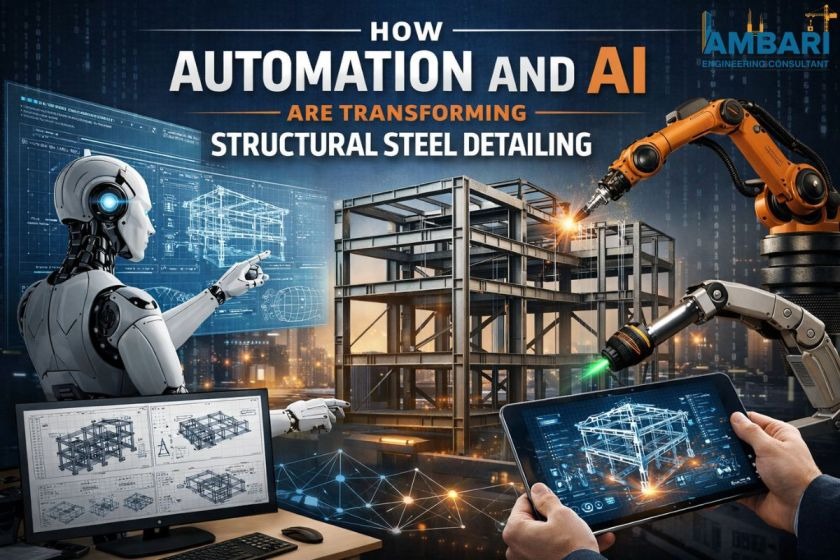
Automation and AI in structural steel detailing can be used to provide safer, quicker, and more precise steel designs to modern projects. Even the steel bridge design consultants in India today use the smart tools to minimize the number of errors and work within the strict timeframes. Therefore, it is now necessary to learn how AI assists in steel detailing among both engineers and project owners.
Technology is applied in Ambari Consultant as a support system and not a substitute for engineering judgment. The future of steel detailing is that balance.
Automation of steel detailing refers to the process of creating, verifying, and maintaining steel drawings with little human intervention through the use of software. AI, however, goes a step higher. It uses previous data, identifies trends, and proposes more intelligent detailing choices.
Therefore, automation makes repetitive work more efficient, whereas AI makes people think more efficiently.
Together, they help in:
Nevertheless, these systems are operated by humans. They support engineers and do not substitute them.
The steel structures are getting complicated. Structures are higher, bridges are longer, and deadlines are reduced. So, it is no longer sufficient to detail manually.
The major causes of this change are:
Additionally, automation assists teams to handle high amounts of data without getting lost. This comes in handy particularly where there are various stakeholders.
Automation at Ambari Consultant is only embraced when it contributes to the quality of the project.
In steel detailing, accuracy is very important, as even a minor error can lead to delays or waste of materials. The AI tools can minimize such risks by learning from past projects.
AI improves accuracy by:
For example, in steel detailing services in Vadodara, AI-assisted checks are used to verify that drawings are as intended to be made before they are passed to fabrication teams.
Nevertheless, experienced engineers are always the ultimate decision-makers. AI assists in decision-making and does not eliminate accountability.
Yes, automation is very cost-effective and time-saving when applied appropriately.
Here is how automation helps:
Moreover, quicker detailing enables the project to shift to fabrication at an earlier date. This reduces the total project duration.
Automated workflows in steel connection detailing services in Vadodara are used to create the correct connection details more quickly, and engineers make critical checks. Therefore, automation helps in efficiency without affecting quality.
Despite the power of AI, it cannot overcome human experience. Structural steel detailing is a matter of judgment, coordination, and responsibility.
Human experience is required in:
AI is not aware of the constraints of the real world, such as access to the site, restrictions on fabrication, or the challenges of the construction sequence. However, the presence of experienced engineers is the main focus of any project.
Technology assists engineers at Ambari Consultant, rather than vice versa. This will be a method of trust and accountability.
Automation in Ambari Consultant is not taken in vain but with the aim of enhancing quality and retaining control of engineering.
Their approach includes:
This moderate approach will make sure that automation does not decrease reliability at the expense of productivity. Additionally, it creates confidence in clients since decisions are transparent and traceable.
Automation and AI are most useful in large infrastructure projects since they comprise thousands of components.
In projects handled by steel detailing companies in Vadodara, automation helps manage:
In the case of bridge projects, AI-assisted detailing can be used to ensure consistency when handling various load zones. Consequently, engineers will be able to work on safety and performance rather than on repetitive writing.
Despite the numerous advantages of AI, it also has drawbacks.
Common challenges include:
AI systems can only perform effectively in the case of accurate data. When inputs are inaccurate, then outputs will be inaccurate. Hence, it has to be reviewed by humans.
However, this knowledge of limits assists teams to apply AI in a prudent manner as opposed to trusting it blindly.
The future of steel detailing is in cooperation between machines and human beings.
Expected trends include:
Nevertheless, human intervention will always be needed in ethics, accountability, and safety. Moreover, AI will always be a strong helper, but not a decision-maker.
Companies such as Ambari Consultant are still investing in technology and human capital, which makes them grow sustainably.
Structural steel detailing is changing with the use of automation and AI that enhances speed, accuracy, and coordination. Nonetheless, it relies on responsible use and professional control. In India, the steel bridge design consultants today only believe in smart systems when they are guided by experience. With a balanced approach, Ambari Consultant demonstrates that safer and smarter steel structures are formed by using technology and human expertise in a combined manner.
No, AI assists detailers but does not substitute engineering judgment and responsibility.
Automation is most effective in medium- and large-scale projects that have repetitive parts.
Engineers should do final checks, although AI identifies numerous problems.