.png)

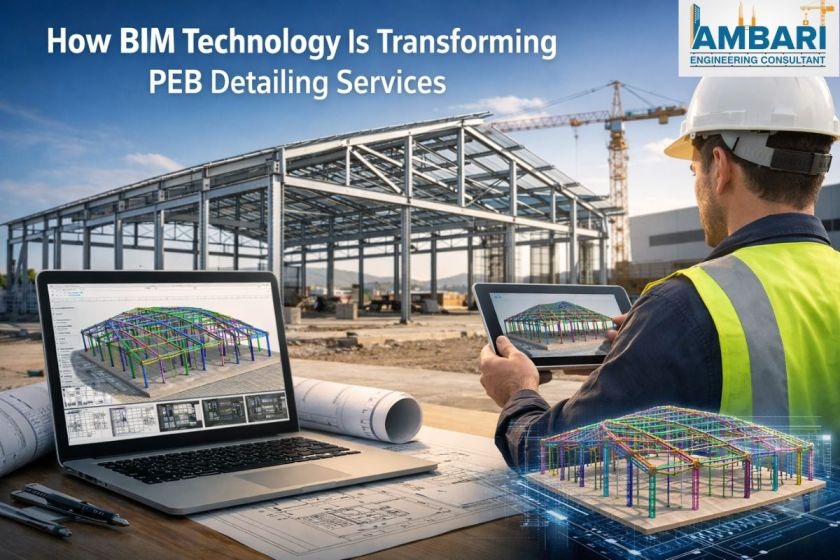
BIM technology is revolutionizing the design and detailing process of pre-engineered buildings (PEB). It enables teams to create accurate 3D models, detect errors early, and improve collaboration. As a result, PEB detailing has become faster, more precise, and highly efficient. Companies like Ambari Consultant are using BIM to deliver smarter and more reliable engineering solutions.
Building Information Modeling (BIM) is a digital platform used to create detailed 3D models of buildings. These models include structural components, materials, dimensions, and the relationships between different elements. In PEB projects, BIM allows engineers to visualize the entire structure before construction begins.
Unlike traditional 2D drawings, BIM helps designers understand how each component interacts with others. This makes it easier to identify design issues at an early stage and reduce errors during execution.
The significant advantages of BIM in PEB detailing are:
Due to these benefits, many companies offering PEB design and detailing services in India are shifting toward BIM-based processes.
Additionally, firms like Ambari Consultant are using BIM to enhance accuracy, streamline project workflows, and ensure timely project delivery.
PEB structures should be described with great attention as they contain a lot of steel elements, connections, and prefabricated elements. Even the slightest errors in the description can lead to fabrication problems.
BIM will solve this problem by allowing the engineers to model the structure digitally.
The following are some of the major reasons why BIM is used in the contemporary world:
Architects, engineers, and contractors can work on the same model.
The conflicts of structural and architectural elements are determined by BIM.
The 3D models are easier to learn by the teams compared to detailed drawings.
During the design, problems are solved, and therefore construction is simplified.
Therefore, the engineering firms offering drafting and detailing services in India are implementing BIM as the means of enhancing the quality of the project.
BIM can also be applied in providing uniformity in design, fabrication, and construction stages.
Accuracy is one of the biggest issues of steel detailing. The slight error in the size or attachments can lead to costly fabrication mistakes.
BIM minimizes such risks.
The manner in which BIM will improve the accuracy of detailing is as follows:
Engineers can easily make structural changes without changing the entire design.
The software generates correct member sizes, bolt details, and connection drawings.
BIM systems identify structural conflicts among the members.
Detailed drawings are generated directly from the model.
Owing to these features, steel detailing services in Vadodara are integrating BIM in their workflow to maintain a high quality of detailing.
Moreover, BIM models give the same updated information to the stakeholders.
One of the most important processes of PEB projects is fabrication. The members of steel must be produced according to the drawings.
BIM plays an important role in the construction of accurate fabrication and shop drawings.
The engineers will be able to use BIM-based workflows to:
In this way, fabrication teams are provided with clear instructions for manufacturing.
This is what is making the majority of the engineering companies offering fabrication shop drawing services in Vadodara rely on BIM models to improve efficiency in production.
Furthermore, BIM ensures that the fabrication drawings are aligned with the actual structural design and that mistakes are eliminated during the assembly process.
The other notable advantage of BIM is that it can be utilized in estimating costs. The BIM model contains much information about the materials and quantities; therefore, the engineers can calculate the costs of the project more accurately.
This feature is quite convenient in large PEB projects.
The benefits of BIM in estimation are:
The following table shows how BIM is better than the traditional methods in terms of estimation:
| Factor | Traditional Method | BIM-Based Method |
|---|---|---|
| Material estimation | Manual calculations | Automated quantity extraction |
| Error possibility | Higher | Very low |
| Cost control | Difficult | More accurate |
| Project planning | Limited visibility | Data-driven planning |
As a result of these advantages, BIM helps engineers to provide good pre engineered building estimation in India.
This implies that customers can make budgets more confidently.
The construction sector is becoming more technologically oriented. Therefore, BIM is no longer an option for numerous engineering firms.
Organizations that use BIM have a number of long-term benefits.
The causes of significant adoption are:
Moreover, BIM helps companies to maintain consistency in the quality of different projects.
At Ambari Consultants, they are engaged in the use of the existing BIM software in order to offer effective PEB detailing solutions to industrial and commercial buildings.
However, the future of PEB engineering is becoming efficient and reliable due to this digital revolution.
BIM technology is transforming the way engineers design and detail pre-engineered buildings. It improves accuracy, collaboration, and fabrication planning. As the construction industry becomes digital, BIM will still be a significant tool in any engineering project.
Moreover, those companies that adopt BIM can offer more effective and faster solutions. Companies like Ambari Consultants are now helping customers to achieve better project outcomes through the application of high-end modeling and engineering capabilities.
Therefore, the BIM-based processes in India are also improving the design and detailing services of the PEB, which is turning the projects more efficient and future-oriented.
BIM is a computer-based modeling method that is used in the design and coordination of steel structures.
It also increases the accuracy of designs, detects conflicts, and ensures better coordination of engineering teams.
Yes, BIM can detect conflicts in designs at the initial stages, which can help avoid mistakes in construction.