.png)

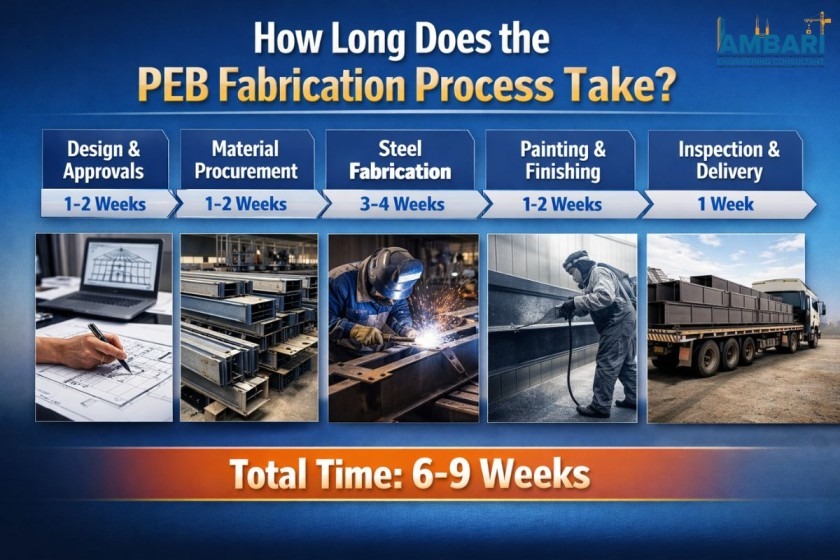
The PEB fabrication process normally requires approximately 4–8 weeks, depending on the project size, design complexity, and factory capacity. Smaller projects are usually completed faster due to simpler designs and fewer material requirements. In contrast, large industrial buildings may take longer because of detailed engineering and higher production demands.
With proper planning and coordination, delays can be minimized. Working with experienced professionals such as Ambari Consultant helps streamline the process from design to fabrication, ensuring better time management, efficiency, and smooth execution without unnecessary interruptions.
The duration of the process depends on multiple factors. It is not limited to just steel production; instead, the overall timeline is influenced by several interconnected stages working together.
Major factors include:
Additionally, collaborating with experienced teams such as Ambari Consultant ensures better coordination and helps prevent unnecessary delays throughout the process.
To understand the overall timeline, it is important to divide the fabrication process into phases. Each stage contributes to the final duration.
Each step depends on the previous one. Even a small delay in one phase can impact the entire schedule.
This is the initial and most important phase, usually taking 1–2 weeks depending on project complexity.
During this phase:
Services like PEB design and detailing services in India play a crucial role here. Accurate detailing ensures smooth fabrication without rework.
Additionally, timely approvals from clients and engineers are essential. Without approvals, fabrication cannot proceed.
This is the core phase where actual fabrication takes place, typically lasting 2–4 weeks.
The process includes:
Companies offering pre-engineered building fabrication in India use advanced machinery to speed up production. Automated systems help reduce manual errors and improve efficiency.
However, projects involving custom components may require additional time.
Once fabrication is completed, components are prepared for dispatch. This phase usually takes 3–7 days.
It includes:
Delivery timelines depend on distance and logistics. If the site is not ready, unloading and erection may be delayed.
Therefore, proper coordination between fabrication and site preparation is essential for timely project execution.
The PEB fabrication timeline can be summarized as follows:
| Stage | Time Required |
|---|---|
| Design & Detailing | 1–2 weeks |
| Material Procurement | 3–5 days |
| Fabrication Process | 2–4 weeks |
| Finishing & Dispatch | 3–7 days |
| Total Time | 4–8 weeks |
This schedule may vary slightly depending on project conditions.
Proper estimation plays a key role in saving time. Without accurate planning, delays are almost unavoidable.
With correct estimation, you can:
Estimation should never be overlooked in PEB projects, as it directly affects fabrication speed.
A well-planned design reduces fabrication time, while poor design can lead to confusion and rework.
Using professional design services ensures:
Experienced consultants like Ambari Consultant focus on practical designs that are easy to manufacture and construct, improving overall project efficiency.
Detailing is often overlooked, but it directly impacts the speed of fabrication.
Using professional PEB detailing services provides:
As a result, workers can carry out fabrication without confusion, saving both time and cost.
To speed up the process, follow these simple steps:
Working with trusted experts like Ambari Consultant also helps manage timelines more effectively.
When properly planned, the PEB fabrication process is fast and efficient, typically taking around 4 to 8 weeks depending on project size, design complexity, and overall planning.
A structured approach minimizes delays and ensures smooth workflow at every stage. With professional support from Ambari Consultant and reliable pre-engineered building fabrication services in India, projects can maintain quality, improve speed, and be completed on time without unnecessary complications.
Small projects typically take around 3 to 5 weeks to complete.
Yes, delays can be minimized with proper planning and professional assistance.
The most common delay factors are design approvals and material availability.
Yes, custom designs can slightly increase production and processing time.
The fastest approach is to finalize the design early, ensure material readiness, and work with experienced consultants for smooth execution.