.png)


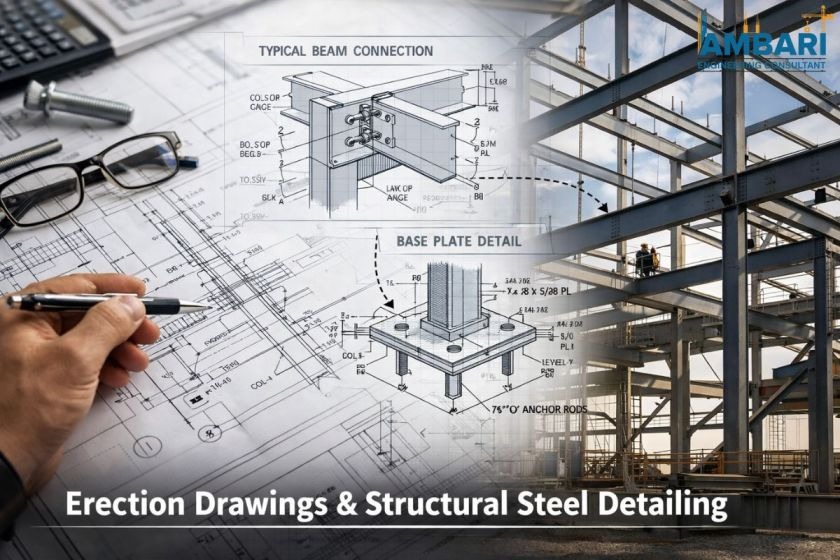
PEB erection drawings are step-by-step visual instructions that assist site engineers in assembling steel structures in the right way. In simple terms, they indicate the direction that each member takes, the way the parts are attached, and the order in which installation should occur. When working on-site, learning how to read these drawings correctly helps save time, reduce errors, and improve safety.
Furthermore, companies such as Ambari Consultant assist engineers in making drawings clear and accurate, making execution easier and faster. Therefore, learning how to read PEB erection drawings is not just an option but an essential skill for every site engineer.
Proper erection drawing reading has a direct effect on the quality and speed of the project. Even a small error in interpretation may result in misalignment, delays, or costly rework.
Here’s why it matters:
Additionally, engineers who follow the correct drawings make project implementation easy and predictable. Companies such as Ambari Consultant focus on clarity in drawings so that site teams can understand and execute them without confusion or misunderstanding.
There are various types of information present in erection drawings. You do not need to memorize everything, but you must understand how to read each section properly to ensure smooth site execution.
Key elements you will find:
These drawings are typically prepared using PEB Design and Detailing Services , ensuring accuracy and clarity before construction begins. Therefore, understanding how to interpret each part step by step is essential for smooth and efficient erection work.
The starting point in PEB erection drawings is the General Arrangement (GA) drawing. It provides a complete overview of the building and helps engineers understand the overall structure before moving to detailed drawings.
Use the following step-by-step procedure:
GA drawings act as a roadmap for the entire project. Once you understand them correctly, reading other drawings becomes much easier. This is a common approach followed by professionals in Pre-engineered Building Design India to ensure accurate and efficient project execution.
Connection details are essential because they show how structural components are joined together. Understanding these details ensures proper installation, strength, and structural stability.
Focus on these points:
These details are usually prepared under PEB Detailing Services, where all joints and connections are clearly defined. Ignoring connection details can lead to serious structural stability issues and safety risks on site.
Every PEB structure includes identification numbers for each component, making assembly easier and more organized on site. This marking system helps engineers identify and install members correctly.
How to read markings:
Furthermore, this marking system is a crucial part of PEB structure detailing and helps engineers avoid confusion during erection. Therefore, it is always important to verify markings before installation to ensure smooth and accurate project execution.
Even experienced engineers can make mistakes when reading erection drawings. Avoiding these errors helps save both time and project costs while ensuring smooth execution on site.
Common errors include:
Additionally, outdated drawings should never be used on site, as they can create serious structural and coordination problems. This is why professional steel detailing services focus heavily on version control, accuracy, and proper documentation to ensure safe and efficient project execution.
PEB erection drawings are an essential skill that every site engineer should develop. They help ensure proper execution, reduce errors, and improve on-site safety. By understanding layout, connection details, and marking systems, engineers can manage projects more efficiently and with greater confidence.
Moreover, hiring professionals such as Ambari Consultants makes drawings clear, accurate, and easy to understand, simplifying site work and improving execution. The right knowledge combined with reliable PEB design and detailing services ultimately leads to smooth project execution and successful completion.
They instruct engineers to construct buildings properly and securely at the site, ensuring accurate installation and structural safety.
Connection details provide proper joining, strength, and structural stability, ensuring that all components are safely connected.
Steel members can be identified using mark numbers and matching them with drawings and the Bill of Materials (BOM).
Most errors occur due to ignoring details, using outdated drawings, or making assumptions instead of verifying information.