.png)

Pre-engineered buildings (PEB) are constructed with factory-manufactured components that are erected on-site. These are pre-designed components that are fast, precise, and economical. The concept is straightforward: design, make, and assemble.
Companies such as Ambari Consultant are keen on detailed planning to ensure that all components fit perfectly during installation. Moreover, understanding these structural elements helps improve project decision-making and enhances long-term performance.
Any PEB structure is based on fabrication. It guarantees that every steel element is manufactured with precision before arriving at the site. This minimizes mistakes, saves time, and enhances durability.
Additionally, factory-controlled fabrication ensures consistent quality. Compared to traditional construction methods, it reduces material waste and speeds up the overall process.
The main advantages of proper fabrication are:
Due to these advantages, pre-engineered building fabrication in India is widely used in warehouses, factories, and commercial buildings.
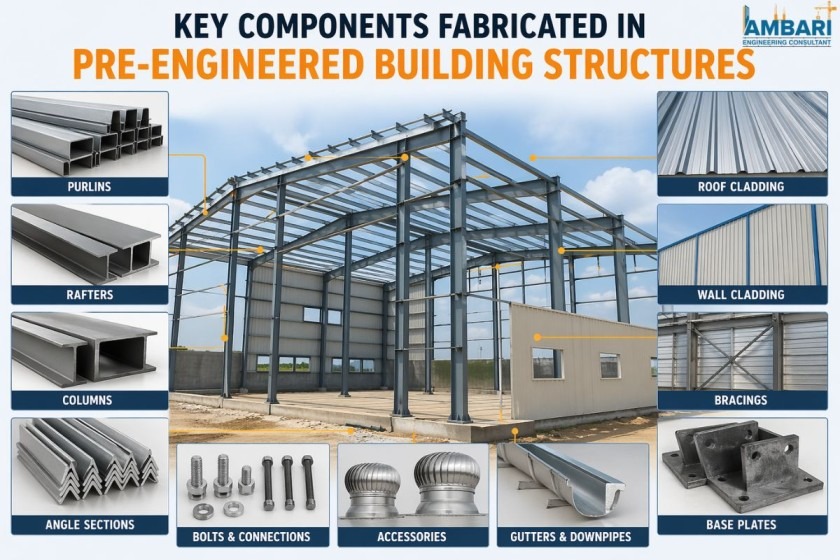
Primary components bear the bulk of the building load. These are the strongest parts of the structure, designed to support weight, wind, and other external forces.
Primary components of most PEB systems include:
These components form the backbone of the building. They are typically made from cut, welded, and shaped steel sections manufactured in controlled factory environments.
Moreover, these elements are developed using modern engineering practices, ensuring safety, reliability, and long-term performance even under heavy loads.
The primary structure is supported by secondary components that help distribute loads evenly. Although lighter in weight, they play a crucial role in maintaining overall stability.
Typical secondary components include:
These components improve the overall strength of the structure and prevent unwanted movement. Additionally, they help maintain proper alignment during installation.
Modern PEB structure detailing ensures that these elements are accurately spaced and properly connected to achieve maximum efficiency and performance.
Roof and wall systems protect the building from external elements such as rain, heat, and wind. They also improve insulation and overall energy efficiency.
Common materials include:
These systems are lightweight yet strong, and they are easy to install and maintain.
An efficient roof and wall system provides:
Therefore, selecting the right materials is essential to ensure long-term building performance and durability.
All components in a PEB structure are connected through various types of connections. Even a well-designed structure can fail without properly designed and executed connections.
Typical types of connections include:
These connections are carefully designed to ensure safety, flexibility, and structural integrity. They also allow for easy assembly and disassembly when required.
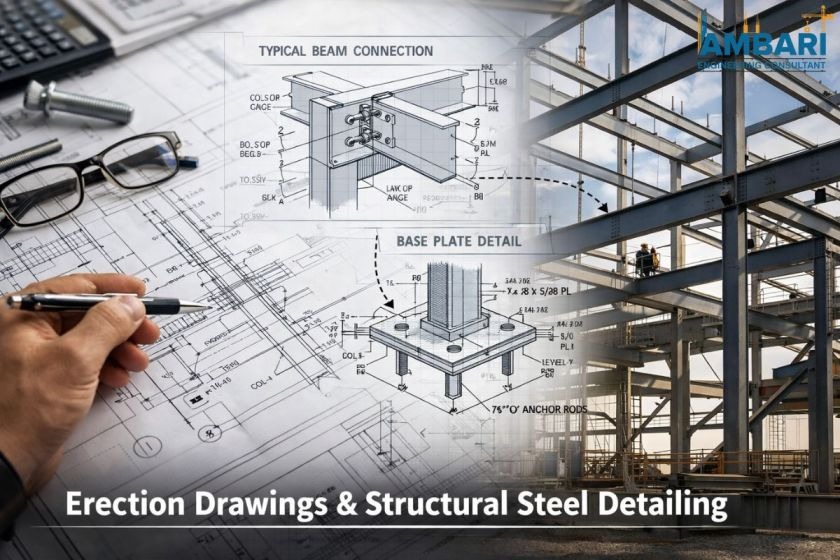
In professional projects, structural steel detailing services in India ensure that all connections are clearly defined in drawings, reducing installation errors and improving overall efficiency.
Accessories may be small, but they significantly enhance the functionality and usability of a building. These components complete the construction and make the structure ready for use.
Important accessories include:
These elements improve ventilation, natural lighting, and water management. Additionally, they enhance the overall user experience.
Companies such as Ambari Consultant ensure that these elements are properly integrated into the design without compromising structural strength.
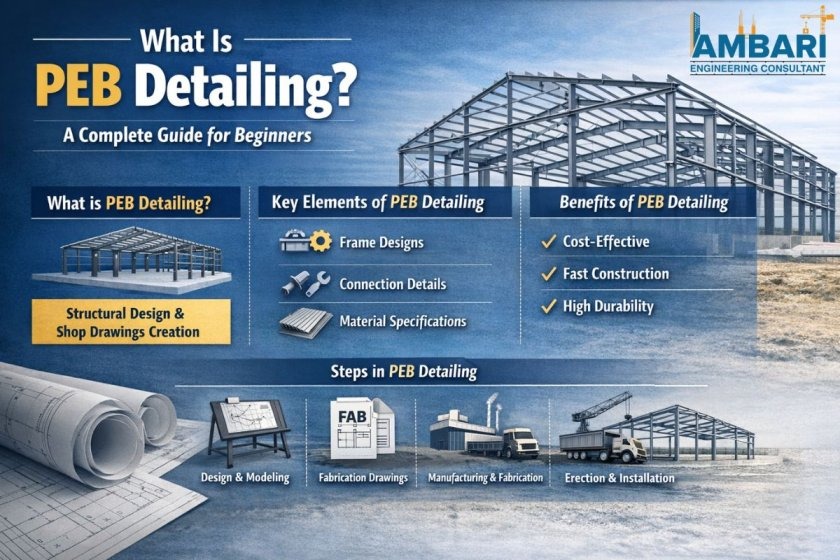
Detailing is the process of creating accurate drawings used for fabrication and assembly. It acts as a critical reference for manufacturers and engineers.
Good detailing ensures:
PEB design and detailing services in India play a vital role in delivering high-quality structures. These services help transform design concepts into practical, constructible components.
Additionally, detailing improves coordination between design and fabrication teams, leading to faster and more efficient project completion.
The design phase determines the effectiveness of each component. A good design ensures safety, efficiency, and long-term durability.
Key design considerations include:
Pre-engineered building design in India has evolved with advanced tools and engineering expertise to deliver optimized and cost-effective solutions.
Additionally, professional consultants such as Ambari Consultant focus on creating designs that are both economical and structurally strong, ensuring maximum value for clients.
Pre-engineered buildings rely on well-designed and accurately fabricated components to deliver strength, speed, and efficiency. From primary structural frames to small accessories, every element plays a vital role in the overall performance of the building. Therefore, selecting the right design and detailing partner is essential.
With professional support from Ambari Consultant, companies can ensure high-quality construction and long-term durability. As demand continues to grow, pre-engineered building fabrication in India is setting new benchmarks in modern construction.
Primary components include columns and rafters, which carry the main structural load of the building.
Fabrication ensures accuracy, reduces errors, and speeds up the construction process.
Secondary components support the primary structure and help distribute loads evenly across the building.
Detailing provides precise drawings that simplify fabrication and installation, reducing errors and improving efficiency.