.png)

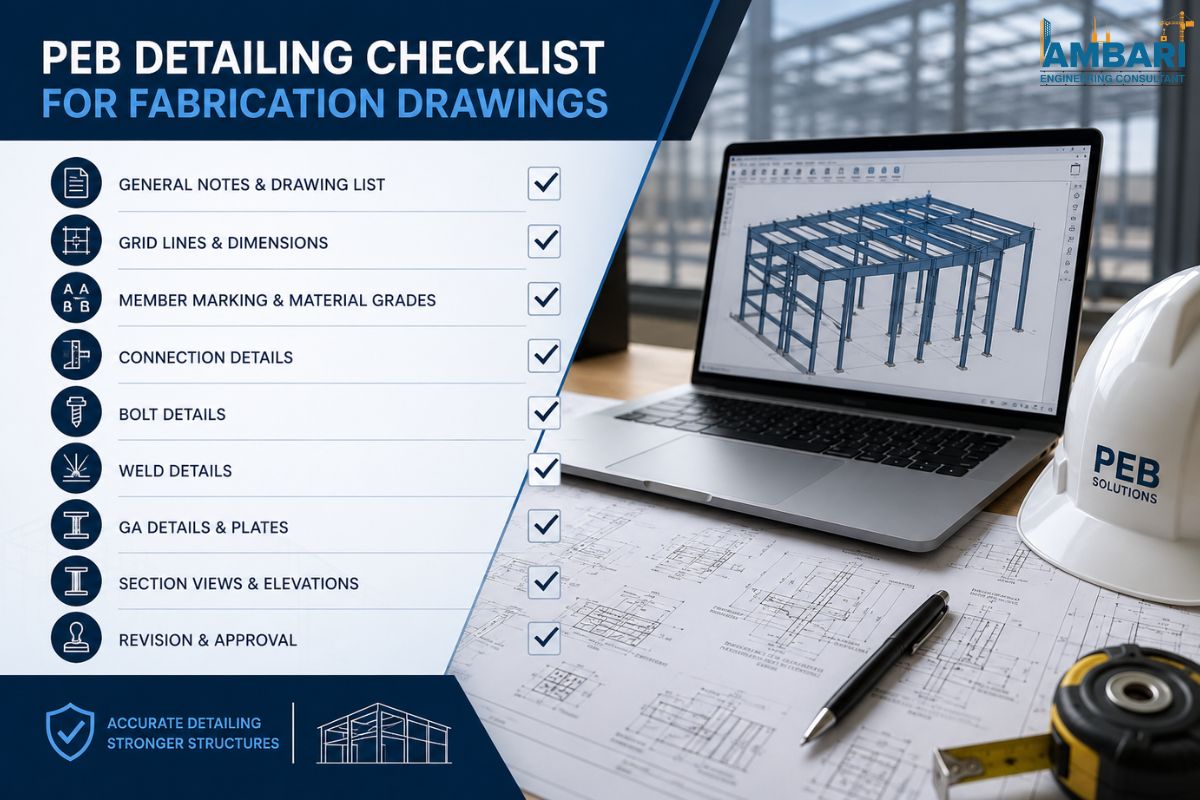
Fabrication drawings are the key to making a pre-engineered building project run smoothly from design to construction. Any missing dimension or unclear connection detail can cause delays, material waste, and/or fitting issues on site. So by having a suitable detailing checklist, teams can avoid errors and enhance the quality of the fabrications from the start.
With the increasing automation and speed of fabrication work, accurate detailing is important for many industrial projects today. But firms such as Ambari Consultant concentrate on realistic detailing requirements, aiding fabricators, engineers, and website teams to collaborate and prevent confusion.
A fabrication drawing is not a mere sketch. It serves as the working blueprint for cutting, welding, drilling, and assembling. If it's one thing that's incorrect, the complete structure might need rework later. That is why it is always advisable for experienced teams to use a checklist when they are about to post drawings.
When using a checklist, you can help by:
A lot of industries today are making use of accurate PEB design and detailing services as industrial projects are now becoming executed in an improved manner and time. Furthermore, clients are looking for drawings to be easily read and for direct production use when it comes to fabrication drawings.
The information in a fabrication drawing should be unambiguous and define each component of the object being drawn. Fabrication shop workers should know the drawing and should not have to ask engineers for clarification frequently.
Normally, the following details are important:
| Drawing Element | Why It Matters |
|---|---|
| Member dimensions | Prevents cutting mistakes |
| Hole locations | Ensures proper bolt fitting |
| Plate thickness | Maintains structural strength |
| Welding details | Improves fabrication accuracy |
| Section views | Helps understand complex joints |
| Part numbers | Makes assembly faster |
However, include north direction, revision number, project name, and scale in drawings. These are easily overlooked and result in confusion during fabrication and erection.
In the industrial sector, fabrication shop drawing services in Vadodara are a more popular choice, as manufacturers need to have clear and detailed production drawings with all necessary dimensions and assembly references.
One of the most important aspects of fabrication drawings is connection detailing. Proper detailing of connections is necessary for even the best-designed structure to not fail during installation.
Common connection information includes:
Moreover, it is important to specify the bolt grade, weld size, plate dimensions, and spacing when indicating connections. Incomplete weld symbols, bolts, or other information can cause delays for fabricators.
This is where the expertise of the PEB Detailing Services comes in handy, as they use connections that are easy to fabricate to minimize confusion on the shop and site.
Fabricators must have precise information regarding materials prior to production. So, it's important to have a material specification list for each drawing.
The checklist should check the following:
When information about the materials is not clear, procurement teams can end up ordering the wrong steel sections, causing expensive delays. In addition, correct labeling also plays a significant role in inventory control within fabrication facilities.
In the era of large industrial projects, pre-engineered building fabrication in India has become very process-centric. Therefore, the clarity of materials is now a key issue in sustaining production speed and quality within drawings.
Some errors may seem insignificant in the detailing but will cost a lot during the building phase. Hence, it is important to review drawings for approval.
Some of the typical problems:
In some cases, such as when anchor bolt locations don't align with base plates, site installation can grind to a halt. Likewise, if you set the level on a wrong beam, it could cause the roof to be off level throughout the structure.
Fabrication drawings are typically reviewed several times by experienced teams at Ambari Consulting prior to release. This process can help minimize site-level correction work and enhance overall project efficiency.
Drawing accuracy is not the only aspect of good detailing. It is also crucial to ensure coordination with designers, fabricators, and erection teams.
Teams should verify prior to final approval the following:
However, frequent coordination meetings will help to identify any clashes early. This will minimize the rework that needs to be done later during the manufacturing process.
Additionally, modern PEB structure detailing also uses software-based clash checking to prevent connection conflicts before production begins. Consequently, projects go faster and without numerous site issues.
Engineers should use a structured checklist to review before creating fabrication drawings.
| Final Review Points |
|---|
| All dimensions are verified |
| Connection details completed |
| Welding symbols checked |
| Material specifications confirmed |
| Section marks correctly labeled |
| Revision notes updated |
| The Bill of Materials is attached |
| Fabrication sequence reviewed |
This is the final check to make your drawings better and save a considerable amount of time in the fabrication process.
A cornerstone of successful steel fabrication work is accurate detailing. Using a checklist ensures no production errors, enhances site installation, and saves time and money. With the ongoing expansion of industrial projects, the need for precise PEB design and detailing services has grown steadily, ensuring businesses remain efficient and accurate in their fabrication processes.
Therefore, the details of fabrication drawings can make execution more straightforward and enhance the performance of the entire project and are understood by companies like Ambari Consultants.
They direct the teams creating the pieces with precise measurements, material specifications, and connection details.
Correct connections ensure the correct fit, safety of the structure, and speed of erection.
Errors lead to rework, delays in fabrication, material waste, and further works to be done on site.