.png)

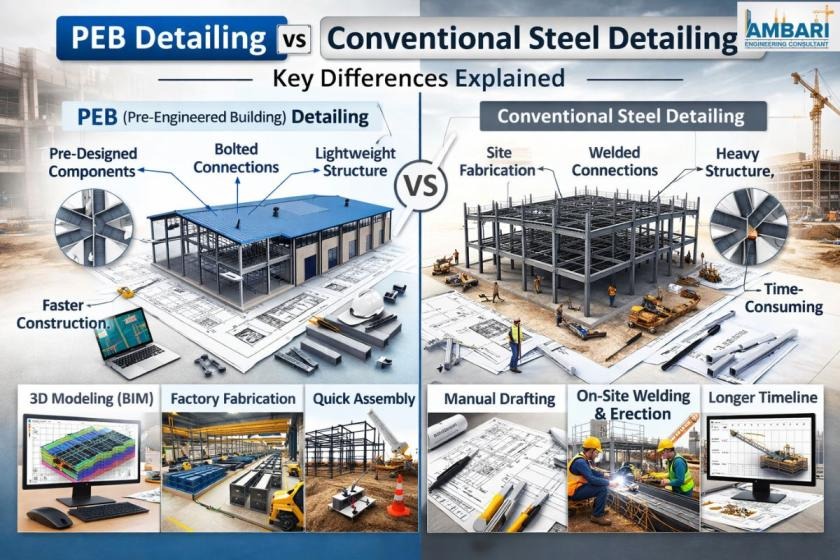
The major difference between PEB detailing and conventional steel detailing is in the approach to design, speed, cost, and flexibility. PEB has ready-made systems, which are executed faster, whereas conventional detailing is more customizable but time-consuming. The selection of the appropriate approach is based on the size of your project, budget, and time.
However, when working with professionals such as Ambari Consultants, companies can clearly understand which detailing technique is best suited for their projects. This helps prevent delays and ensures quality construction from the beginning.
Pre-Engineered Building (PEB) detailing is concerned with pre-manufactured steel elements that are planned and manufactured at the factory and then transported to the construction location. These are then assembled within a short period of time, such as a ready-to-install system.
Furthermore, the engineers in PEB design and detailing services in India make use of advanced software to come up with precise designs. The designs are standardized, and this saves time and errors.
The main characteristics of PEB detailing:
Additionally, quality is constant as the majority of work is carried out in a controlled environment. PEB detailing is thus suitable for projects that require speedy completion without losing strength.
Traditional steel detailing is the process of designing each element separately. It is mostly applied in complicated structures where customization is essential.
As an example, projects undertaken under steel detailing services in Vadodara usually include detailed drawings of beams, columns, and joints. These drawings are highly specific and structure-focused.
Key features of conventional detailing:
The process is more time-consuming because each part is unique. Moreover, it requires qualified professionals to ensure accuracy at every stage of the detailing process.
Knowing the differences will assist in making the correct decision. Below is a simple comparison:
| Factor | PEB Detailing | Conventional Detailing |
|---|---|---|
| Design Approach | Standardized | Fully customized |
| Speed | Faster | Slower |
| Cost | More economical | Higher cost |
| Flexibility | Limited | High |
| Accuracy | High due to automation | Depends on manual detailing |
In projects that require steel connection detailing services in Vadodara , traditional approaches are generally used because connections require detailed consideration. However, PEB systems also use optimized connections for faster assembly.
Therefore, the final decision depends on whether speed or flexibility is more important for your project.
It does not have a one-size-fits-all solution. Both approaches have their own advantages, and the correct choice depends on your project requirements.
Choose PEB detailing if:
Use traditional detailing when:
Businesses can assess these factors properly with the help of Ambari Consultants. Their experience ensures that the detailing method aligns with project objectives and avoids costly mistakes.
Detailing is a significant factor in construction success, as it directly influences project cost and schedule.
In drafting and detailing services in India , proper detailing ensures efficient use of materials, reduces wastage, and prevents rework.
Impact on cost:
Impact on time:
Moreover, proper detailing improves communication between engineers and fabricators, making the construction process smoother and more predictable.
The two approaches are used in various industries and types of projects.
PEB detailing is usually applied in:
Conventional detailing is used in:
An example is Steel Bridge Design consultants in Vadodara, which typically use conventional detailing due to the complexity of bridge structures. These projects require precise calculations and customized designs.
These two approaches to detailing have advantages. PEB detailing is most effective in terms of speed and cost savings, whereas conventional detailing is most suitable in terms of complex and customized projects. As such, it is highly important to know what you need in your project before making a decision.
However, by consulting the professional services of Ambari Consultants, the companies will be able to select the appropriate strategy and make the implementation process successful. It can be planning or design, but the right method chosen enhances efficiency and minimizes risks.
Therefore, in the case of projects that need high-end solutions such as PEB design and detailing services in India, the correct decision can result in success in the long run.
PEB detailing refers to the creation of factory-produced steel components that are assembled quickly at construction sites.
It depends on project complexity, design requirements, budget, and construction timeline.
PEB detailing is generally more economical because it is faster to implement and uses less material.
PEB is suitable for simple structures, while conventional detailing is more effective for highly customized and complex buildings.