.png)

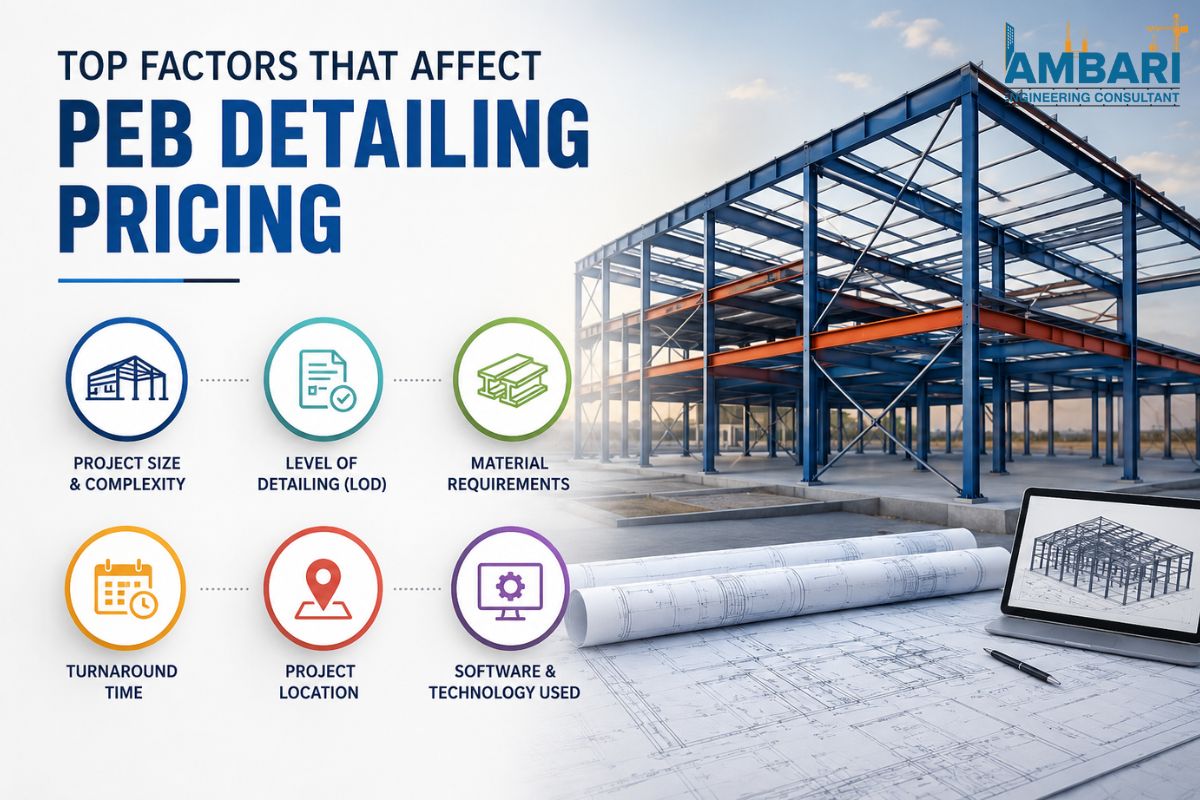
The cost of PEB detailing services depends on several factors, including project size, design complexity, detailing accuracy, revisions, and project delivery timelines. Understanding these factors allows businesses to estimate budgets more effectively and avoid unexpected expenses during project execution.
The demand for PEB detailing services in India continues to grow as project owners, fabricators, and contractors seek cost-effective detailing solutions without compromising quality. Whether planning a warehouse, industrial shed, manufacturing facility, or commercial building, understanding the factors that affect detailing costs can support better decision-making and improved project planning.
At Ambari Consultant, clients receive practical detailing solutions designed to balance engineering accuracy, project efficiency, and cost optimization, helping ensure successful project outcomes from design through construction.
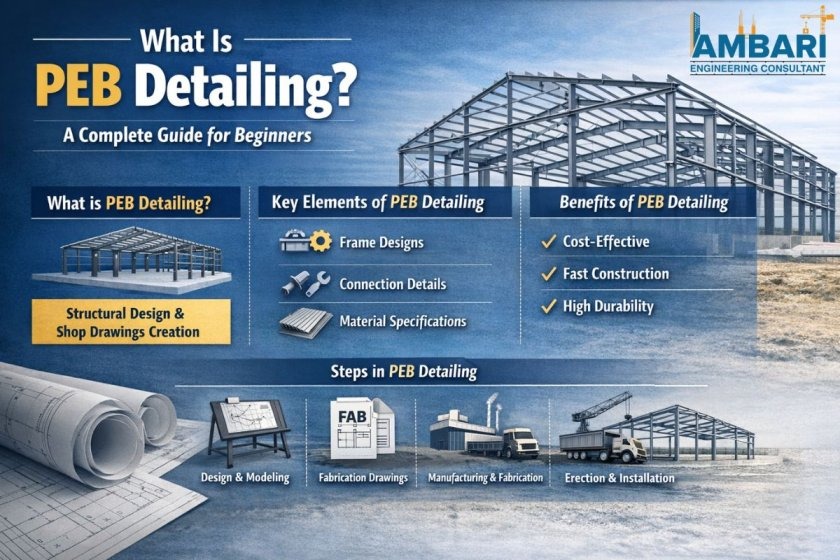
PEB (Pre-Engineered Building) detailing is the process of creating detailed fabrication and erection drawings for steel building components. It ensures that all structural elements are accurately engineered, fabricated, and assembled during construction.
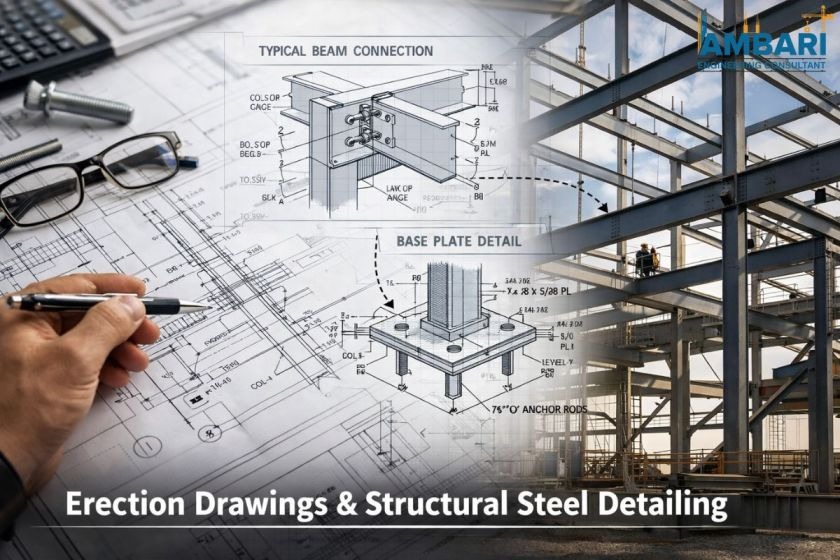
Detailing converts engineering concepts into practical drawings that fabricators and construction teams can confidently use throughout the project lifecycle.
Detailing is a crucial process that plays a significant role in the quality of Pre engineered building design India.
The overall size of the building is one of the most important factors affecting detailing costs.
Larger projects typically require:
For example, detailing a 10,000 sq. ft. warehouse requires considerably less effort than detailing a 200,000 sq. ft. industrial facility.
Some PEB projects are significantly more complex than others, which directly impacts detailing effort and pricing.
Project costs increase when designs include:
The greater the engineering coordination required, the higher the detailing effort and project cost.
Why complexity matters:
Different projects require different levels of detailing depending on fabrication and construction requirements.
| Detailing Scope | Impact on Pricing |
|---|---|
| Basic fabrication drawings | Lower cost |
| Advanced shop drawings | Medium cost |
| BIM-integrated detailing | Higher cost |
| Full erection and assembly drawings | Premium cost |
Projects requiring highly detailed models generally cost more because engineers spend additional time creating, coordinating, and validating the model.
Leading detailing companies use advanced BIM platforms and 3D steel modeling software to improve project quality and efficiency.
These technologies provide:
While advanced software delivers significant project benefits, licensing costs, skilled manpower requirements, and quality assurance processes can influence detailing pricing.
This is why professional detailing companies invest in modern technology to deliver long-term value rather than focusing solely on reducing initial project costs.
Frequent design changes are one of the most common reasons for increased detailing costs.
Revisions may occur due to:
Each revision requires drawings to be updated, reviewed, coordinated, and rechecked, increasing engineering effort and project timelines.
Cost-Saving Tip:
Finalizing project requirements at an early stage helps minimize detailing costs and reduces the risk of schedule delays.
Projects with aggressive delivery schedules generally require additional resources and therefore cost more.
Fast-track projects may require:
Although faster delivery can help maintain construction schedules, it often increases overall detailing costs.
Projects designed according to national or international standards often require additional engineering effort and documentation.
Common standards include:
Compliance reviews, documentation requirements, and additional quality checks contribute to the overall detailing cost.
Knowing the code requirements is crucial for any business looking for reliable pre-engineered building estimation in India and to make an accurate estimate of the cost.
Hiring professional PEB detailing services offers several advantages that improve project efficiency, accuracy, and cost control throughout the construction process.
Accurate drawings help minimize manufacturing mistakes, resulting in smoother fabrication processes and improved product quality.
Well-prepared erection drawings are easier for site teams to understand, helping improve productivity and accelerate project execution.
Proper detailing reduces steel wastage and improves material utilization, contributing to overall project savings.
Fewer design conflicts and coordination issues lead to smoother project execution and reduced construction risks.
Detailed and accurate drawings help prevent costly rework, unexpected modifications, and budget overruns.
For many organizations, partnering with an experienced consultant such as Ambari Consultant can improve project predictability and generate long-term cost savings.
A manufacturing company planning a new industrial facility initially expected multiple design revisions throughout the project lifecycle.
However, by establishing strong coordination between the architect, structural engineer, and fabricator before the modeling phase, the project team reduced revisions by nearly 40%.
As a result:
This example highlights the importance of early planning and coordination in reducing detailing expenses and improving overall project efficiency.
PEB detailing costs are influenced by several factors, including project size, design complexity, detailing requirements, software usage, revisions, delivery schedules, and compliance standards. Understanding these variables enables project owners to plan budgets more accurately and select the right detailing partner.
When evaluating PEB design and detailing services in India, working with experienced professionals can help reduce risks, improve drawing accuracy, and maximize project value. Ambari Consultant provides comprehensive engineering support and practical detailing solutions that contribute to efficient and cost-effective project execution.
Project size, design complexity, detailing scope, revisions, and delivery timelines are the primary factors that influence pricing.
Complex structures require additional modeling, engineering checks, connection design work, and coordination efforts, which increase detailing time and cost.
Yes. Early coordination helps minimize revisions, reduce errors, and lower overall detailing expenses throughout the project.
BIM-based detailing may involve a slightly higher upfront investment, but it often reduces rework and improves project efficiency through greater accuracy.
Accurate estimation helps project owners plan budgets effectively, manage resources efficiently, and avoid unexpected costs during construction.