.png)

AISC 303 and Structural Steel Detailing: What Detailers and Fabricators Need to Know
Table of Contents
- Key takeaways
- What does AISC 303 actually cover?
- How does AISC 303 shape the detailing workflow?
- Where do AISC 303 and Australian standards diverge?
- Detailing mistakes that trigger AISC 303 disputes
- What fabricators should expect from a detailing partner?
- Choosing a connection detailing provider
- A working checklist for AISC 303 projects
- Comparison table: AISC 303 vs AS 4100 in practice
- Conclusion
- Frequently asked questions
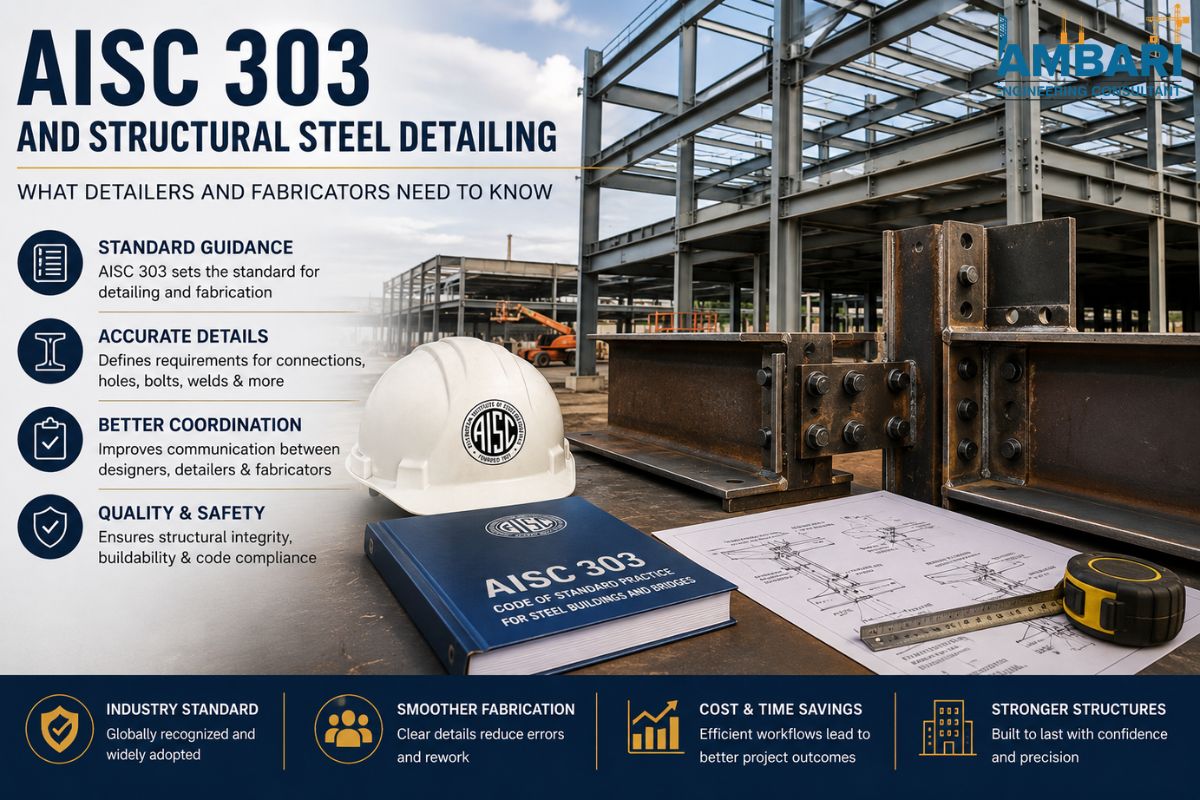
AISC 303, which is also known as the Code of Standard Practice for Steel Buildings and Bridges, outlines the rules and regulations for steel projects in the US, including connection development, types of fabrication tolerances applicable for such projects, and how RFIs will be settled before the steel gets out of the shop floor. In the case of detailers who work with American clients or undertake dual-code projects, AISC 303 is the only answer to queries that arise from a drawing set.
Providers of structural steel detailing services that Australian teams turn to regularly encounter situations that require the combination of the framework provided by AISC 303 as well as AS 4100 on projects that involve the combination of both codes. Should there be an error at the detailing stage, the costs will not vanish; they will just transform into a rework that was implicitly counted on.
Key takeaways
- While the scope of the AISC303 includes tolerances of fabrication and responsibilities of connections, it does not deal with calculations relating to member sizing.
- Whether governed by AS 4100 or any other standards, projects in the US require knowledge of AISC 303.
- Most mistakes that lead to costly projects are caused by vague responsibilities for connections and not due to bad drawings.
- Reliable detailing partners treat RFIs as part of the plan rather than a signal.
What does AISC 303 actually cover?
The AISC 303 is not a design code such as AS 4100 or AISC 360. Instead, it is a guide on projects concerning steel work. The code describes who does what, when, and what tolerances are observed. It outlines the tolerances of fabrication and erection, requirements of mills, and responsibilities for designers.
That last point trips up more people than anything else in the document. AISC 303 defaults connection design to the fabricator unless the engineer of record explicitly takes it on in the contract documents. Skip that clause, and you end up with a detailer producing connection drawings nobody has actually stamped. That's a problem that shows up at the worst possible time: during steel erection, not during design review.
For firms delivering steel detailing services in Australia to overseas clients, this single clause is usually the first thing worth clarifying on any AISC-referenced job. It determines who signs off on shop drawings before fabrication starts.
How does AISC 303 shape the detailing workflow?
A detailer working to AISC 303 isn't just drawing steel. They're documenting compliance with a specific tolerance and submittal sequence. The code lays out how erection drawings, shop drawings, and RFIs move between fabricator, detailer, and engineer, and it gives dimensional tolerances that determine how tight a connection can be drawn before it turns into a fit-up problem on site.
A few things follow from that:
- Fabrication tolerances (length, camber, sweep) get built into the drawing dimensions from the first draft, not patched in after a shop flags an issue.
- Connection details reference the applicable AISC specification edition, since tolerance and design values shift slightly between editions.
- RFIs follow a structured path back to the engineer of record instead of getting resolved informally between detailer and fabricator.
However, firms producing steel fabrication drawings services in Australia for US-bound work build this sequence into their internal review process. A missed RFI cycle on an AISC job tends to cost more time than the same miss would on a domestic AS 4100 job, largely because of the time-zone lag between an Australian drafting team and a US-based engineer.
The scale of the numbers involved is part of why this discipline matters. The structural steel sector of Australia provides roughly 1.6 million tons of fabricated steel every year. The amount spent on steel construction and infrastructure by Australia each year is approximately A$3.4 billion. The IBISWorld suggests that by 2026, the fabrication sector of the industry will be worth A$8.6 billion. This industry has about 2,000 businesses nationwide; therefore, fabrication errors can be costly once they appear on the shop floor.
Where do AISC 303 and Australian standards diverge?
Australian structural steel work runs primarily under AS 4100 and AS/NZS 5131, not AISC 303. The two frameworks don't map onto each other cleanly, and a detailer who assumes tolerance values or connection defaults carry across from one to the other is asking for a rejected shop drawing.
A few differences come up constantly:
- Tolerance basis: AS/NZS 5131 sets fabrication and erection tolerances by "construction category," a risk-based classification. AISC 303 applies a more uniform tolerance table regardless of project category.
- Connection responsibility: AS 4100 leaves connection design allocation to the contract, similar to AISC 303, but Australian contracts more often assign it to the structural engineer upfront rather than defaulting to the fabricator.
- Documentation language: US drawings reference AISC shapes and ASTM bolt standards, while Australian drawings use AS/NZS designations. It sounds like a minor detail until a bolt spec gets transposed incorrectly between systems.
Furthermore, providers offering steel detailing services in Australia to clients running parallel US and Australian operations usually keep separate template libraries for each code rather than forcing one drawing standard to serve both markets. It's a small operational choice, and it leads off a lot of avoidable errors.
Detailing mistakes that trigger AISC 303 disputes
Most AISC 303 disputes aren't really about drafting quality. They're about assumptions nobody wrote down.
- Unclear connection ownership - If the contract is silent, AISC 303 puts connection design on the fabricator by default, as noted above. Detailers who don't flag this early sometimes find out mid-project that the engineer assumed they'd already handled it, or the other way around.
- Tolerance stacking - A beam within tolerance sitting on a column within tolerance can still produce a connection that's out of tolerance once both variances compound. Detailers who check individual tolerances but skip the cumulative check miss this often.
- Edition mismatches - Referencing an outdated AISC specification edition on the drawing title block seems trivial until a submittal gets rejected because the connection capacities were calculated against a superseded value.
- Skipping the RFI trail - Verbal confirmations from a site call don't hold up later. AISC 303 assumes a documented RFI process, and firms delivering steel connection detailing services in Australia on AISC-referenced jobs generally insist on written RFI responses before revising a connection detail, even when the fix looks obvious.
What fabricators should expect from a detailing partner?
A fabricator handing off a project shouldn't have to re-explain the code framework every time. A detailing partner who actually knows AISC 303 should be able to confirm connection design responsibility before the drawing set starts, not after a submittal bounces back. They should apply the correct tolerance table from the first shop drawing draft, flag edition mismatches between the contract documents and current AISC practice, and manage RFIs on a set schedule instead of reacting to them as they come.
Therefore, with steel prices in Australia currently sitting in the AUD $1,500 to $2,300 per tonne range for mild grades, rework from a missed detailing step lands directly on project margin. There's not much room to absorb a redrawn connection or a re-cut member because a tolerance table got misapplied.
Choosing a connection detailing provider
Connection detailing is where AISC 303 knowledge matters most directly, because connection design is the one area the code explicitly assigns, by default, to whoever is doing the detailing.
Before engaging a provider, it's worth asking:
| Question | Why it matters |
|---|---|
| Which AISC edition do they detail by default? | Prevents capacity mismatches from outdated tables |
| Do they separate AISC and AS 4100 template libraries? | Avoids cross-code drafting errors on dual-standard jobs |
| How do they log RFIs? | Determines whether disputes have a documented trail |
| Who reviews connection design internally before submittal? | Confirms accountability sits with a qualified reviewer, not just the drafter |
A provider that answers all four without hesitation has probably handled enough AISC 303 work to avoid the failure points covered above.
A working checklist for AISC 303 projects
Before a drawing set goes out for fabrication on an AISC-referenced job, it's worth confirming:
- Connection design responsibility is documented in the contract, not assumed.
- The correct AISC edition is stated on every sheet's title block.
- Cumulative tolerance checks have been run across connected members, not just individually.
- RFIs are logged in writing with dated responses.
- Bolt and material specs use ASTM references consistently, without AS/NZS carryover.
Firms delivering structural steel detailing services Australia clients trust for cross-border work tend to run this exact sequence as a standing checklist rather than a one-off review. That's really the difference between a smooth handoff and a shop floor delay.
Comparison table: AISC 303 vs AS 4100 in practice
| Aspect | AISC 303 (US) | AS 4100 / AS-NZS 5131 (Australia) |
|---|---|---|
| Primary function | Contractual and tolerance framework | Design standard with tolerance provisions in AS/NZS 5131 |
| Default connection responsibility | Fabricator, unless contract states otherwise | Contract-dependent, often assigned to structural engineer |
| Tolerance structure | Uniform tolerance table | Risk-based construction category |
| Bolt/material references | ASTM standards | AS/NZS designations |
| RFI handling | Structured, code-referenced process | Project-specific, less formally codified |
Conclusion
AISC 303 makes sense once the underlying logic clicks: it exists to strip ambiguity out of who does what, and to what tolerance, on projects where a lot of money passes through a lot of hands. The mistakes detailers make against it usually aren't about drafting skill. They're skipped confirmations, outdated editions, RFIs that never got written down.
For fabricators and engineers running AISC-referenced work out of Australia, that discipline is what a good detailing partner should bring to the table without being asked twice. Ambari Consultant works through this framework on every cross-code project, checking connection ownership and tolerance compliance before a drawing set ever reaches the shop floor.
.jpeg)