.png)

Structural steel detailing services turn structural drawings into fabrication and erection blueprints, which the contractors and manufacturers can use for the construction process. Skipping this very significant phase in the process may lead to poorly aligned connections and lost materials. Doing steel detailing properly will accelerate the fabrication process and allow the workers to avoid dangerous situations at the site, as well as ensure that the project has a clear path from mill order to erection.
Key takeaways
- The steel detailing service providers in the USA can detect and solve clashes before it impacts the operations at the shop floor level.
- The fabrication drawings and erection drawings are developed for different roles and audiences on the project.
- Steel connection detailing can cause serious RFI and delays if it does not have the right oversight.
- Outsourced teams with experience and knowledge can produce superior results compared to internal teams.
Why does detailing sit at the center of every steel project?
If you ask any project manager who watched a crane come to a halt because a beam was unfit for installation, he will most likely tell you one of two things: the drawing was incorrect or a proper check was not performed. Structural steel detailing goes beyond simple paperwork that connects engineering with fabrication. It puts into paper a drawing that can be followed by the welders, fitters, and ironworkers when working on the site with real steel structures.
Structural engineers concentrate on the basic design criteria such as path of loads, sizes of members, and compliance with codes. However, their drawings may lack certain fabrication details. There is no telling where holes should be, how beams should be cut to avoid other members, or what bolt pattern should be used for a connection. Detailing closes that gap.
The American Institute of Steel Construction treats detailing as its own discipline within the Code of Standard Practice for Steel Buildings and Bridges, and there's a reason for that. Errors caught at the detailing stage cost a red-line and a re-run. The same error caught in the field costs a day of crane time, a change order, and a general contractor who's now behind schedule.
That's the actual value of structural steel detailing services USA. They sit between design intent and shop reality, and whether that handoff goes smoothly or badly usually decides whether the rest of the project runs clean.
What fabricators actually need from detailing drawings?
Fabrication shops don't build from architectural renderings or engineering calc sheets. They build from shop drawings, and those drawings have to answer specific, practical questions that engineering documents never touch.
A usable set of steel fabrication drawings services in USA covers:
- Exact member lengths, cuts, and copes for every piece
- Hole locations and sizes for bolted connections, dimensioned to fabrication tolerance
- Weld symbols specifying type, size, and location per AWS standards
- Material grades and piece marks tied to the erection sequence
- Camber, where specified, plus any shop-applied coatings or finishes
Moreover, piece marks matter more than most people outside a fabrication shop realize. Every piece in a steel package, down to a small clip angle, needs an identifier that stays consistent from the shop drawing to the erection drawing to the physical tag welded on the steel. Break that chain and shops lose time hunting for pieces, or worse, they install the wrong one, and nobody notices until erection.
Here's something experienced detailers pick up on that newer teams often miss: shop capability isn't uniform. A detailer who knows a particular fabricator runs CNC plasma tables, has certain bending limits, or leans toward specific connection types for their crew's skill level will produce drawings that move through the shop without friction. Generic drawings that ignore those realities tend to generate more RFIs, not fewer, no matter how technically correct they are.
How do erection drawings protect field crews?
Erection drawings do a completely different job than fabrication drawings, and treating them as an afterthought is a mistake that shows up on job sites more often than it should.
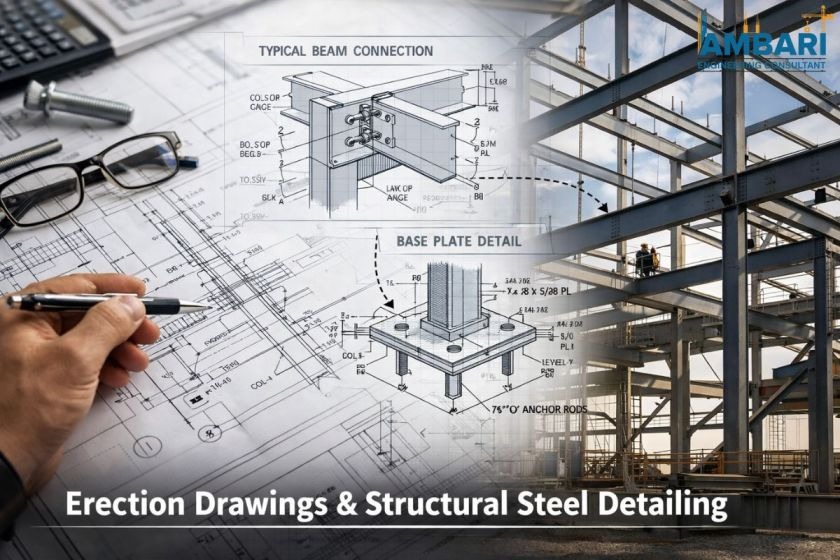
Structural erection drawings services in USA need to communicate sequences, not just geometry. A crew hoisting steel doesn't just need to know what a beam looks like. They need to know:
- The order pieces go up in, especially on multi-story or braced-frame structures where sequence affects stability
- Temporary bracing requirements before anything gets a permanent connection
- Crane pick points and rigging notes for oversized or awkward members
- Bolt-up sequences for slip-critical connections
OSHA's steel erection standard, 29 CFR 1926 Subpart R, exists because sequencing mistakes during erection have been a major cause of construction injuries and fatalities. Erection drawings that clearly mark temporary bracing and connection points are part of how a site actually stays safe, not just a documentation requirement.
Therefore, one thing worth flagging: erection drawings crammed with information nobody in the field will use are almost as bad as drawings missing something critical. A crew doesn't have time to dig through excess annotation while a beam hangs from a crane thirty feet up. The best erection drawings are lean and sequenced logically, and they highlight only what actually changes what a crew does next.
Connection detailing: where most projects go wrong
If one area consistently eats up schedule, it's connections. Steel Connection Detailing Services in USA cover how members join, and this is where engineering judgment and drafting precision have to line up, not just coexist.
Two connection types show up in most projects:
- Simple shear connections transfer vertical load only. They're common at beam-to-column and beam-to-girder joints in gravity framing, and while they're relatively straightforward, they still demand correct bolt sizing, gauge lines, and edge distances per AISC 360.
- Moment connections transfer shear and moment, and they leave far less room for error. Welded or bolted moment connections in seismic zones follow AISC 341 seismic provisions. A mistake here isn't just a scheduling headache. It's a structural performance issue.
A problem that keeps recurring across the industry is connections "designed by note," where the structural engineer specifies a required capacity and leaves the detailed design to the fabricator or detailer with minimal coordination. That works fine when the detailing team has real engineering competency and stays in close contact with the engineer of record. It goes badly when detailing gets rushed, capacities never get verified, or someone copies a standard detail that doesn't actually fit the geometry in front of them.
Furthermore, this is where a firm like Ambari Consultant earns its place on a project. Teams that understand both the engineering behind connection design and the practical limits of shop fabrication catch these mismatches on paper, before they become someone's problem on-site.
In-house detailing vs. outsourced detailing
Fabricators have to make a real call here, and there isn't a single right answer.
| Factor | In-House Detailing | Outsourced Detailing |
|---|---|---|
| Cost structure | Fixed salaries regardless of workload | Scales with project volume |
| Turnaround during peak load | Often bottlenecked | Can absorb overflow quickly |
| Software and tooling costs | Shop bears the full cost | Shared across the provider's client base |
| Access to specialized expertise | Limited to in-house team's experience | Broader exposure across project types |
| Communication speed | Immediate, in-person | Requires structured coordination |
A hybrid setup is common among mid-sized fabricators: a small in-house team handles routine work and standard connections, while complex projects, overflow capacity, or specialized work like seismic moment connections go to firms focused specifically on structural steel detailing services in the USA. That keeps the core team lean without turning down bigger jobs when the schedule gets tight.
The old knock on outsourcing was communication lag, and that gap has closed a fair amount as detailing firms have built tighter coordination workflows and faster revision cycles. It's still worth asking a potential partner directly how quickly they turn around RFIs and markups on an active job. Their answer tells you more than their portfolio does.
What to look for in a detailing partner?
Not every detailing provider operates at the same level, and it shows fast once a project is underway. Before committing to one, check:
- AISC and AWS familiarity — Ask how they handle current code editions specifically, not just whether they're "familiar with steel codes."
- Connection design capability, not just drafting — There's a real gap between someone who can draw a connection another engineer designed and someone who understands why that connection was chosen in the first place.
- Shop-specific coordination — A partner willing to learn a fabricator's equipment constraints and crew preferences saves time on every job after the first one.
- Revision responsiveness — Ask how RFIs are handled and how fast markups typically come back during a live job.
- Portfolio depth across structure types — A firm that's mostly done low-rise commercial work may struggle once you hand them something industrial or seismic-heavy.
Furthermore, firms like Ambari Consultant, working across pre-engineered buildings and structural steel detailing, tend to bring a wider range of connection scenarios to the table simply from having seen more variety across project types and regions.
Bottom line
Structural steel detailing isn't a back-office task squeezed between design and construction. It's what decides whether a steel package goes together cleanly or turns into a string of field fixes and change orders nobody wanted. Fabricators get drawings they can actually build from, contractors get erection sequences that keep crews safe, and both sides avoid the surprises that come from rushed or generic detailing.
If your next job involves complex connections, a tight schedule, or coordination across several trades, bring a detailing partner in early. Waiting until fabrication is about to start is how these problems happen in the first place.
Frequently asked questions
1. What's the difference between shop drawings and erection drawings?
Shop drawings guide fabrication of individual pieces in the shop. Erection drawings guide field assembly, showing sequence, piece locations, and temporary bracing needed to safely raise the structure on-site.
2. How long does structural steel detailing typically take?
It depends on complexity, but a mid-sized commercial building generally takes two to six weeks for a full detailing package, factoring in connection complexity and revision rounds.
3. Do detailers need to be licensed engineers?
Not usually. Detailers themselves don't need a PE license, but connection design often needs engineering oversight, especially for moment connections or anything under seismic design categories.
4. What software do detailing services typically use?
Most firms build coordinated shop and erection drawings from a single 3D structural model, which cuts down on the manual drafting errors that used to be routine.
5. Can detailing services help reduce steel tonnage costs?
Yes. A skilled detailer can spot ways to optimize connections and trim unnecessary plate or bolt usage without touching structural capacity, and that shows up directly in material costs.
6. What causes the most RFIs during steel projects?
Connection details that don't match actual field conditions, missing dimensions, and piece marks that don't line up between shop and erection drawings.
7. Is outsourced detailing slower than in-house detailing?
Not necessarily. A strong outsourced team with efficient coordination can turn drawings around faster than an in-house team juggling several jobs at once.
8. How does detailing affect project safety?
Clear erection sequencing and accurate bracing details cut down on the field errors that lead to instability during steel erection, still one of the bigger causes of injuries in construction.
9. What's included in a typical connection detailing package?
Bolt patterns, weld specifications, plate sizes, gauge lines, and capacity calculations for each connection, all coordinated with the overall erection sequence.
10. How do I know if my detailing provider understands seismic requirements?
Ask directly about their experience with AISC 341 provisions and ask to see examples of moment connection details they've produced for high-seismic projects.
.jpeg)