.png)

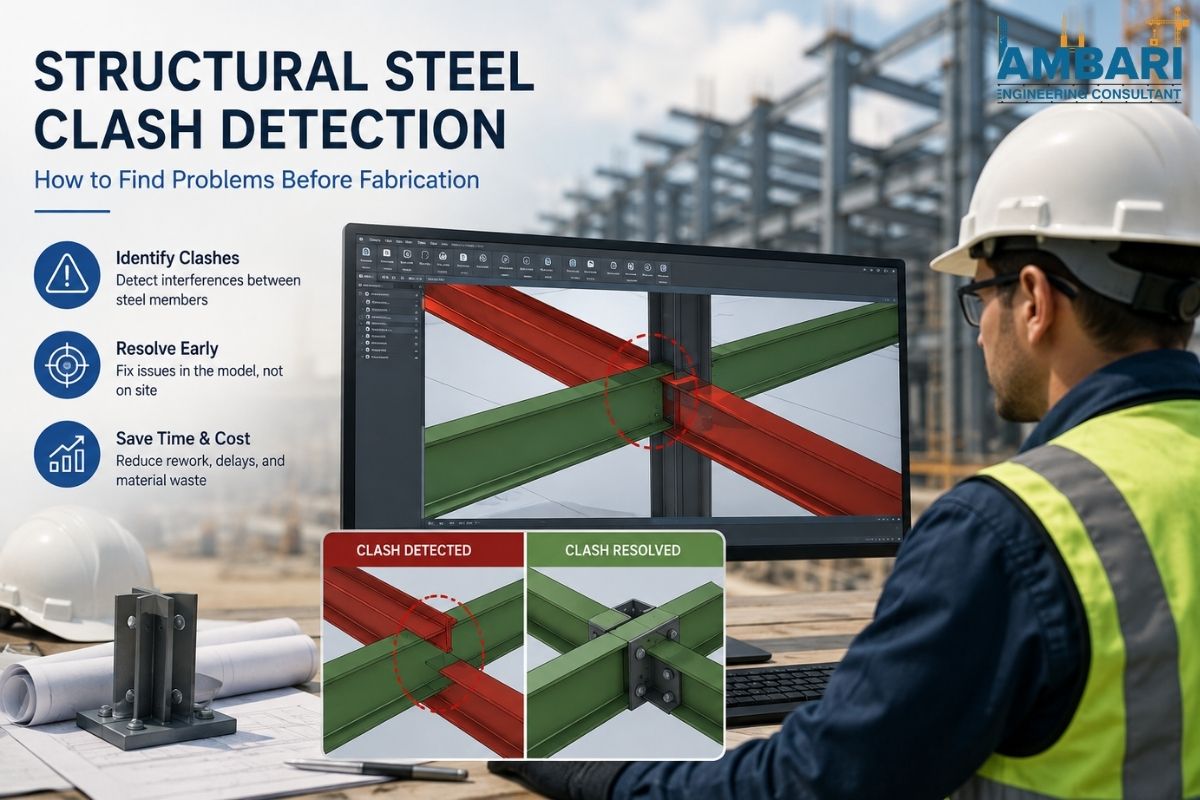
Structural steel clash detection entails verifying steel elements, unions, and holes to see if they conform to architectural and MEP specifications before anything is sent to the production site. If done correctly, it reveals any issues that may have arisen between beams and ducts as well as any interference between connections and dimensional mistakes while those issues are still affordable to resolve. Companies taking advantage of structural steel detailing services USA generally perform this check at the 3D modeling stage before moving to shop drawings.
Checks consist of:
- Verification of steel elements relative to mechanical, electrical, and plumbing installations
- Check of connection plates relative to surrounding structures
- Accessing bolts and welding at tight joints
- Checking openings designed for ducts, pipes, and conduits against beam webs.
Key takeaways
- The majority of structural steel clashes are the result of inadequate coordination between trades and not poor structural steel design.
- Identifying a clash while modeling is significantly cheaper than when the steel has been cut and delivered.
- Connection-level clashes are responsible for more delays on-site than conflicts related to large members.
- It is important to have a disciplined, systematic review that is superior to relying solely on a specific software tool.
What are structural steel clashes actually?
A clash occurs when two elements of a structure attempt to share the same space, or when one prevents the correct installation of another. This provides three types of clash in structural steel.
- Hard clash- Two physical objects share the same space. An example would be a beam going through a column or a brace crossing a duct.
- Soft clash- There is no direct overlap between two physical objects, but there is not enough space for insulation, fireproofing, or maintenance access.
- Workflow clash- Although the geometry appears correct from the design point of view, there is not enough space on the building site to operate a wrench, a bolting machine, or to lower an element during the erection.
The first type is what many people visualize when they hear the word "clash." However, the second and third types of clash can be just as troublesome for construction. For example, although a beam can theoretically be placed half an inch above a duct, fireproofing and hangers can make this impossible in reality.
Where do clashes commonly hide?
Clashes rarely happen in obvious spots- They cluster in a handful of predictable zones on almost every project, and on jobs handled by experienced steel detailing services in USA, those zones get checked as a matter of routine rather than an afterthought.
- Mechanical rooms and ceiling plenums- Steel, ductwork, sprinkler mains, and cable tray all compete for the same few feet of vertical space here. It's the single most common source of conflict on commercial jobs.
- Connection zones near columns- Beam-to-column moment connections, stiffener plates, and doubler plates take up more room than a simple centerline drawing suggests. A Steel Connection Detailing Services in USA review at this stage often catches interference that a general structural model never flags, since the model shows member lines rather than the actual welded and bolted geometry.
- Stair and elevator shafts- Steel framing around these openings has to coordinate with rail systems, door headers, and often fire-rated assemblies. There's little room for error in these tolerances.
- Roof penetrations- HVAC curbs, skylights, and equipment supports frequently land right on top of purlins or joists sized before anyone knew the penetration location.
How does clash detection work in practice?
The mechanics are simpler than they sound. A detailer builds a 3D model of the steel that includes actual connection geometry rather than just centerlines, then checks it against architectural, mechanical, electrical, and plumbing models from other trades.
Here's the general sequence:
- Model the steel at connection-level detail. Centerline-only models miss most real clashes, because bolts, plates, and welds add bulk that a simple line diagram doesn't show.
- Bring in coordination models from other trades. This includes ductwork, piping, sprinkler layout, and sometimes architectural finishes.
- Run interference checks. Depending on project size, this can happen visually, section by section, or through automated overlap detection.
- Log every clash with location, severity, and the trades involved. A spreadsheet works fine for smaller projects. Larger ones need a more formal log.
- Route each clash to the right person for resolution. Not every clash belongs to structural. Some need mechanical rerouting instead.
- Re-check after changes. A fix in one spot can create a new clash two feet away, and this step gets skipped more often than it should.
However, firms offering structural steel detailing services USA typically lock this sequence into a fixed milestone, usually right after the connection design is roughed in but before shop drawings go to the fabricator for approval. Timing matters here. Too early and the connections aren't detailed enough to catch real conflicts. Too late and changes ripple through drawings already close to release.
Drawings, dimensions, and connections: where the real risk lives
Dimensional Accuracy
Steel fabrication tolerances stay tight for good reason. The AISC Code of Standard Practice sets allowable variations for member length, camber, and squareness, because steel doesn't forgive field adjustment the way wood or drywall does. A quarter-inch error in a bracket location, repeated across a dozen connections on a frame, adds up to a real problem by the time steel reaches the erector.
Connection Detailing
This is where clash detection earns its keep. A beam can clear every obstacle along its length and still fail at the connection, where gusset plates, stiffeners, and bolt heads eat into clearance that looked fine on a simplified model. Getting steel fabrication drawings services in USA to reflect true connection geometry, rather than schematic representations, is what separates a clean fabrication run from one full of RFIs.
Openings and Penetrations
Every duct, pipe, or conduit passing through a steel frame needs a coordinated opening. Framing one in after the fact, once steel is already cut, gets expensive fast and can compromise the structure. It's far cheaper to size and locate openings during detailing, when a reinforcement plate or a shifted beam is still just a modeling change, which is exactly the kind of catch reliable steel fabrication drawings services in USA are built to make.
MEP Coordination
Structural and MEP models rarely originate from the same source data, and that's exactly why they conflict. A duct routed at a fixed elevation doesn't know or care that a beam bottom flange sits four inches lower than the architect assumed. Coordination meetings exist to catch this, but only if someone actually brings a model to compare, not a floor plan.
Reviewing and resolving clashes as a team
Clash detection produces a list. What happens after the list determines whether a project stays on schedule or starts slipping. Teams working with experienced steel detailing services in USA tend to formalize this into a repeatable process rather than handling it case by case.
| Step | Who's Involved | Typical Outcome |
|---|---|---|
| Initial flag | Detailer or coordinator | Clash logged with location and severity |
| Triage | Structural engineer, MEP engineer | Decide which trade adjusts |
| Resolution | Responsible trade | Model updated, change documented |
| Verification | Coordinator | Re-run check on affected area |
| Sign-off | Project lead | Clash marked closed |
The biggest failure point isn't detection. It's triage. When nobody owns the decision of who moves first, steel or ductwork, clashes sit unresolved while drawings keep progressing around them. A useful rule of thumb: structural steel is expensive and slow to change once fabrication starts, so lighter trades usually adjust first when the conflict is minor. Major structural conflicts obviously call for engineering judgment instead of a default rule.
What happens when clashes slip through to fabrication?
This is exactly the gap that dedicated Steel Connection Detailing Services in USA exist to close before fabrication starts. Quality management has a long-standing rule sometimes called the 1:10:100 principle: a problem caught at the design stage costs roughly one unit to fix, the same problem caught during production costs about ten times as much, and one that reaches the field costs closer to a hundred times as much. Structural steel follows this pattern closely, because once a beam is cut, drilled, and coated, changing it means undoing finished work instead of editing a drawing.
When a clash reaches the fabrication shop, none of the fixes are cheap.
- Re-cutting or re-drilling delays the shop schedule and burns material.
- Field modification requires certified welders on-site, adds inspection steps, and can void portions of a fabricator's warranty on the affected piece.
- Shipping delays cascade into erection schedules and often stall other trades waiting to follow steel.
- Change orders shift cost responsibility, and disputes over who caused the clash can hold up a project even after the physical fix is done.
Here's a recurring example from mid-rise commercial work: a mechanical duct routed straight through a beam web that had already been fabricated. The fix meant a field-welded reinforcement around a newly cut opening, an inspection hold, and a two-week schedule slip while the reinforcement detail got engineered and approved. In the model, the same clash would have taken an afternoon to resolve.
Practical steps to reduce fabrication and erection problems
Teams already working with structural steel detailing services USA tend to build most of this into standard practice, but a few habits make the biggest difference:
- Model connections in detail early, not just centerlines. The bulk from plates and bolts is where most real clashes live.
- Set a fixed clash-check milestone in the schedule, tied to a specific percentage of design completion, so it doesn't get skipped under deadline pressure.
- Assign clash ownership by trade so there's no confusion about who resolves what.
- Re-run checks after every significant model change, not just once at the end.
- Keep a running clash log visible to all trades, not buried in one engineer's inbox.
- Coordinate openings and penetrations during detailing, before steel is released for fabrication.
- Build in erection sequence checks that confirm pieces can physically be lifted and set in the planned order, not just that they fit statically.
Common clash detection mistakes
- Checking geometry only, ignoring access. A connection can clear every physical obstacle and still be unbuildable if there's no room to swing a torque wrench.
- Running the check too late. Waiting until shop drawings are nearly final means fixes require reworking drawings already close to approval, which slows everything down.
- Treating the clash log as a one-time deliverable. Models change. A clash list from three weeks ago doesn't reflect today's design.
- Assuming centerline models are good enough. They rarely are. Real connection hardware takes up real space that centerline models simply don't show.
- Skipping re-verification after fixes. Moving one beam to resolve a clash can quietly create a new one nearby, and that new conflict often goes unnoticed until fabrication.
- No clear ownership for resolution. When it's unclear whether structural or MEP moves first, clashes sit open while deadlines close in.
Expert insights
The projects with the fewest field problems usually aren't the ones with the most elaborate coordination setup. They're the ones where structural and MEP teams look at each other's models on a fixed schedule instead of waiting for a monthly coordination meeting to surface issues that have been sitting there for weeks.
Fabricators consistently flag connection-level clashes as the most disruptive category, more than large member conflicts. A beam that's six inches off is obvious and gets caught fast. A gusset plate overlapping a duct hanger by half an inch is easy to miss and hard to fix once it's welded. Fabricators who receive accurate steel fabrication drawings services in USA spend far less time chasing RFIs about connection clearances that should have been caught earlier.
There's a quieter pattern worth naming too: rushed projects skip re-verification more often than they skip the initial clash check. Teams remember to look once. They forget to look again after changes, and that's usually where the real damage happens.
Conclusion
Clash detection isn't a box to check before shop drawings go out. It decides whether steel arrives on-site ready to erect or arrives as the start of a change-order fight. Projects that build Steel Connection Detailing Services in USA into the workflow rarely end up relitigating connection clearances after steel has already shipped. The pattern that keeps showing up in projects without field surprises: connection-level modeling, a fixed review schedule, clear ownership of fixes, and a habit of re-checking after every change rather than assuming one pass was enough.
If your project needs a structured clash review before steel goes to fabrication, Ambari Consultant works directly with structural and MEP teams to catch these conflicts while they're still cheap to fix.
.jpeg)