.png)

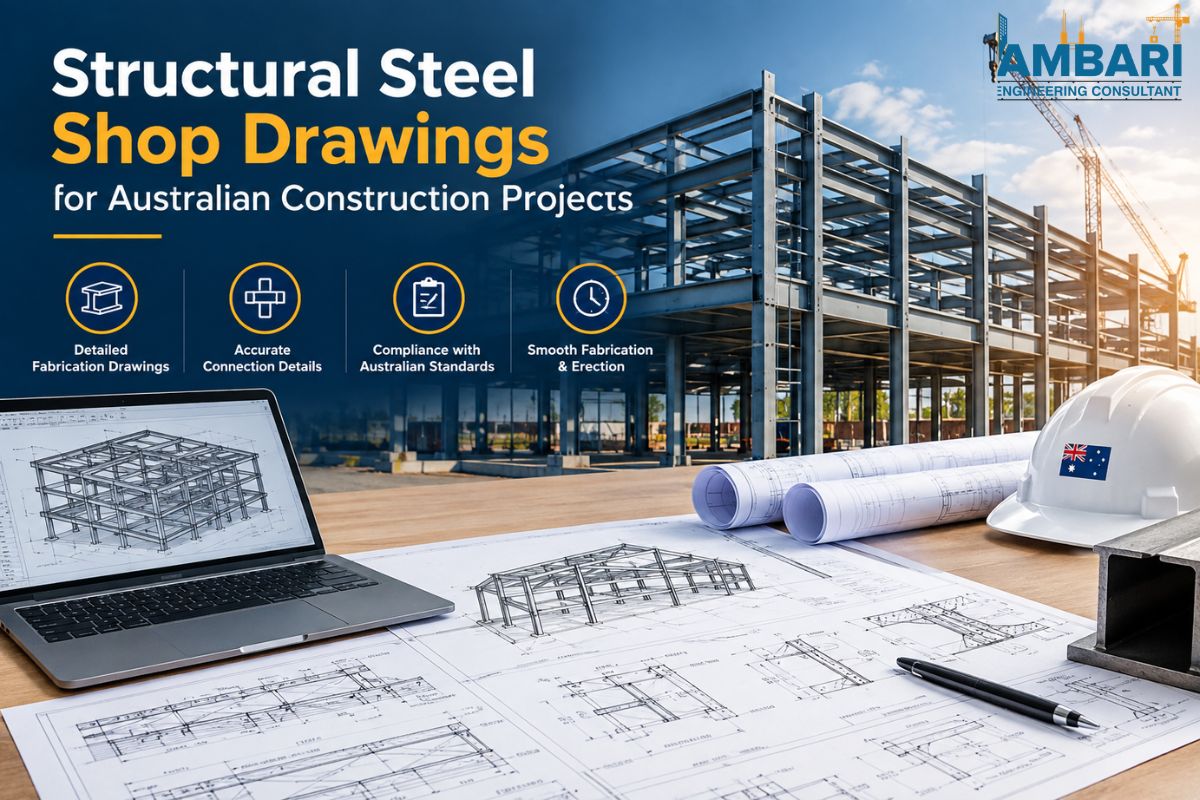
Structural steel shop drawings are documents created at the fabrication stage, which allow an engineer's design to be transformed into operating instructions for a shop where the actual cutting, welding, and assembling will take place. These drawings provide information related to all connections, holes, plates, and bolts, as well as their fabrication details, and they need to meet all local requirements, like Australian standards AS 4100 and AS/NZS 5131, before a single beam can be produced.
Therefore, most construction companies and fabricators would rather have their projects completed promptly and without setbacks by using steel fabrication drawing services in Australia, since errors on paper are very cheap.
The structural engineer's design reveals the column diameter, steel properties, and load to be carried, but it is not enough to allow the fabricator to determine the sequence of drilling the holes, welding the stiffening plate, and bolting the beam to the column on site. This is precisely where the shop drawings come in.
A typical set of shop drawings comprises the following:
Therefore, people discover that the quality of detail is much more important than they thought. A drawing which missed even one dimension or has an unclear weld symbol can result in confusion for the person doing fabrication, with the mistake usually going unnoticed until the piece arrives at the site and turns out to be unsuitable for installation. That is where good fabrication drawing services in Australia come in handy: spotting mistakes on paper before they appear on the construction site.
Steel detailing isn't identical everywhere. Australia's framework has a few genuine quirks worth knowing before drawings go out to fabrication.
AS 4100 governs the structural design of steel, setting out how members are sized and how connections are expected to perform. Shop drawings need to reflect those design assumptions exactly. If a detailer changes a bolt size or a weld length without checking back against the design, the structure can end up with a connection that looks fine on paper but doesn't meet the capacity the engineer calculated.
This is the standard that changed how Australian fabrication projects get scoped. It introduced four Construction Categories, CC1 through CC4, based on how safety-critical a structure or component is. A simple carport frame and a multi-storey commercial building don't carry the same risk, so they shouldn't be inspected, documented, and detailed to the same level. The category an engineer assigns to a project sets the inspection frequency, the welding qualifications required, and how much documentation the fabricator has to produce and retain.
Moreover, overseas-templated shop drawings often fall short on Australian jobs for exactly this reason. A drawing set can be dimensionally accurate and still fail a compliance review, because it doesn't carry the documentation level a given Construction Category demands.
Plate availability, standard hollow section sizes, and typical workshop equipment differ from region to region. Detailers who work regularly on structural steel detailing services Australia projects tend to know which sizes are stocked locally and which ones will trigger a long lead time. That's part of why many builders choose shop fabrication drawing services in Australia over generic overseas drafting: local knowledge, not just drafting speed, is what keeps a job on schedule.
Shop drawings sit between design and fabrication, but their influence stretches in both directions.
Additionally, skip or rush the approval step, you risk fabricating from an unapproved revision. This happens more often than people admit, usually when a project is behind schedule and someone decides the drawings are close enough to start cutting. It rarely ends well, and the rework cost usually dwarfs whatever time was saved.
Ask any fabricator where problems actually show up on site, and most will point to connections before they point to main member sizing. A beam is a beam. A moment connection with the wrong bolt pattern, or a weld that doesn't match the specified size, is where structural capacity and buildability collide.
This is where steel connection detailing services in Australia earn their keep. Good connection detailing accounts for:
However, a connection that's structurally correct but awkward to assemble still causes delays, because someone on site ends up improvising, and improvisation on structural steel is exactly what the approval process was meant to prevent.
Most detailing firms can produce drawings that look complete. Fewer can produce drawings that survive contact with an actual fabrication shop and an actual site crew. A few things worth checking before you commission steel fabrication drawings services in Australia for a project:
Ambari Consultant has built its detailing process around exactly these habits, treating standards compliance and buildability review as part of the drawing package rather than an afterthought. It's the kind of approach that keeps steel projects moving instead of stalling in the review queue.
Ambari Consultant tends to catch these issues early because reviewing for buildability, not just dimensional accuracy, is built into how a drawing set gets checked before it goes out. Additionally, structural steel detailing services in Australia will be helpful.
Structural steel shop drawings ultimately determine if a design on paper transforms into a building that works as intended. Correctly specifying them involves being familiar with AS 4100, operating within the Construction Category of AS/NZS 5131, and genuinely considering connection detailing as an integral part of member sizing and not an afterthought.
The difference between a drawing set that is approved once and one that continually returns with mark-ups is a drawing team that considers standards and buildability as two sides of the same coin, such as Ambari Consultant, who considers both integral elements of the fabrication process.
Structural drawings are issued to reflect design intent, and member sizes are designed by the engineer. That translates into shop drawings, such as dimensions for cutting and dimensioning in the shop, welds, and bolts in the shop.
It is referenced for most structural steel projects, as it is the source for the Construction Categories used to establish the inspection and documentation requirements. Verify the categories with the project engineer before detailing starts.
The time required varies according to project size and complexity of the connections, and is generally from 1 to 2 weeks from approved design to a completed drawing package in a mid-sized commercial project.
Yes, but costly and cumbersome. Changes that are made after cutting has started typically indicate material scrapped and rework, which is much more costly than identifying problems during the pre-cutting stage.
Typically the structural engineer of record, or a delegated reviewer nominated for the project, particularly for anything above Construction Category CC1.
The majority of Australian detailers operate within a 3D modelling platform that creates 2D fabrication drawings, bills of materials, and clash reports all directly from the 3D model.
Since the connections determine the actual loading of the members. However, if a properly sized beam cannot be connected to safely carry the same load, the beam is still a failure in its function.
Yes. Australian fabricators and engineering companies operate with specialist detailing teams instead of big in-house drafting departments, as workload for detailing varies according to the project pipeline.
The fabricator ends up constructing something that isn't what the engineer anticipated, and this can affect the structural capacity and typically results in a stop work order when found.
Steel Connection Detailing Services in Australia adds up when it comes to attention and cannot be treated as routine drafting work if it requires moment frames, transfer beams, seismic bracing, or anything more complex than simple pin connections.
.jpeg)