.png)

Key takeaways
- Correct 3D models make it possible to answer questions before producing and erecting.
- Spotting problems early saves the hassle of making expensive fixes and avoiding delays.
- Track mistakes in the project to identify losses and enhance performance later.
- Good communication and prompt updates help in meeting deadlines.
What are 3D steel models?
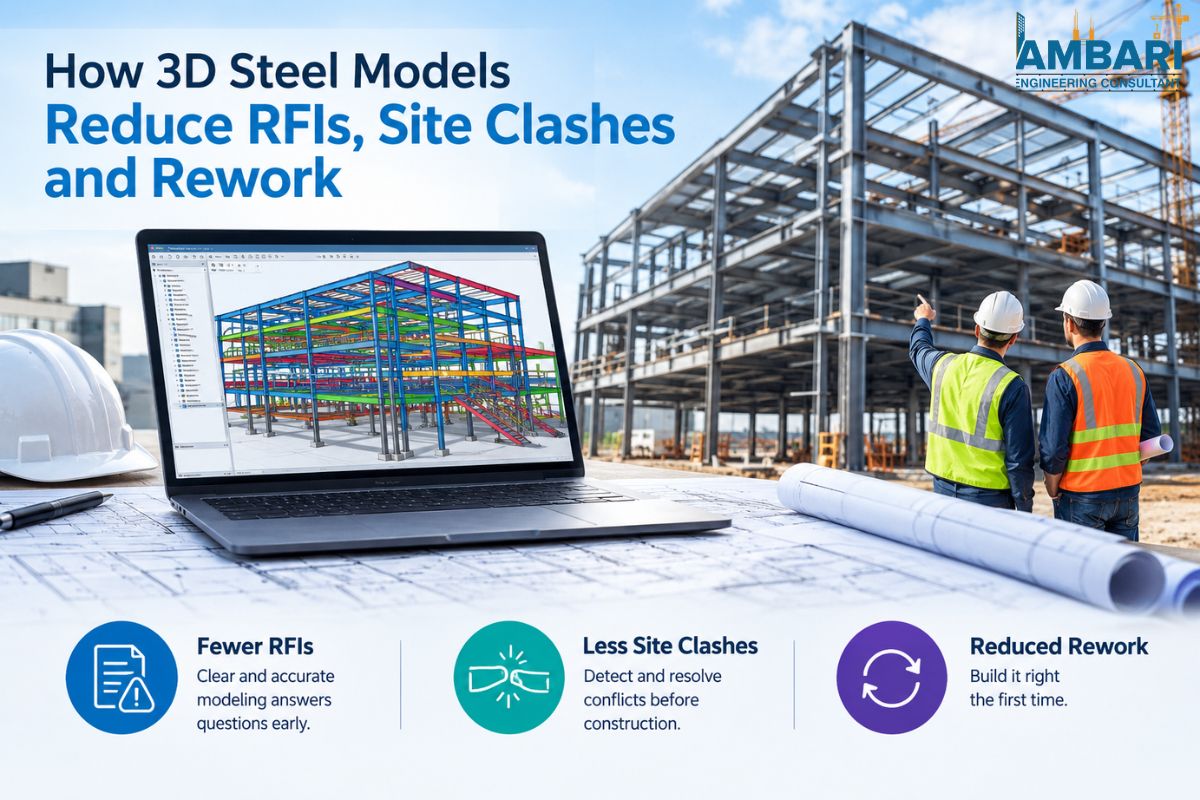
A 3D steel model is a digital model of all members, plates, bolts, welds, and connections in a steel structure. The model is not just a flat plan and elevation but demonstrates how each piece fits in place. Since all the elements are in a common coordinate system, the team can ensure a proper fit before cutting or drilling anything.
Usually, models will consist of beams, columns, bracing, base plates, connections, and other secondary steel like stairs, platforms, and handrails. Information is added to each object such as section size, steel grade, length, finish, and assembly reference. That information is directly transferred into fabrication drawings, cutting lists, bolt schedules, and erection sequences; meaning that the same information isn't typed out several times.
The real value of a model is consistency. The better the chances of no mismatch when the design is from one source, the detailing is from one source, and the fabrication is from one source.
What causes RFIs, clashes, and rework on steel projects?
There are a limited number of causes of most problems on steel projects. Once you have an understanding of them, it's easier to comprehend the role that 3D modelling plays in helping you. Common causes are:
- Inconsistent and incomplete drawings with conflicting dimensions of the same part
- Poor collaboration with mechanical, electrical, plumbing, and façade trades
- Changes to the design that are not reflected in all the impacted sheets.
- Connectivity information that has not been validated with true member geometry.
- Errors in fabrication due to misread notes or outdated revisions
Incomplete or conflicting drawings
If there is a discrepancy between the bolt pattern in the plan and in the elevation, the site team must pause and ask. Every question takes a break, and that break can bleed into crane bookings, delivery schedules & other trades. In the traditional 2D process, these conflicts can only be revealed when the steel reaches the site, and at that time, they are most costly to resolve.
Late coordination with other trades
Steel frames are seldom constructed alone. Ducts, pipes, cable trays and façade supports all require space taken by the steel. Late coordination generally results in cutting, re-drilling, or re-welding members to fix the problem. Those actions are time-consuming and in some instances involve reordering materials which have already been shipped.
How do 3D steel models reduce RFIs?
An RFI is a request for information to clarify documents, typically submitted by the fabricator, erector, or site team when there are questions about the documents. A 3D model reduces these requests, as many of the questions can be answered directly from the model. The team can rotate, section, and measure the connection instead of waiting for an engineer to figure out what it means.
Three features do most of the work:
- Correct geometry: Members sit where they are supposed to, and relationships between parts are immediately apparent.
- Embedded data: Section sizes, grades, and finishes are stored with each part and don't have to be re-entered or guessed.
- Single revision source: Everyone uses the same up-to-date version, eliminating confusion from forgotten old versions of sheets in the site office.
This means that many questions never exist. The ones left are actually true design decisions, and that's where engineering time should be spent. Project teams typically see their RFI log get shorter and more focused, and their responses get quicker since the questions are more succinct.
How do 3D steel models prevent site clashes?
A clash occurs when two elements attempt to take the same space. For steel applications, it could be a brace blocking a duct, a column in the way of stairs, or an anchor bolt that isn't in the concrete pocket. Clash detection will check the steel model against itself and other trade models, identifying any overlaps prior to the beginning of fabrication.
The process works best when it happens in clear stages:
- Model steel to design intent & check member positions.
- Implement the steel model along with architectural, services, and concrete models.
- Peel out clash checks and list them in order of severity.
- Solve each conflict with the appropriate designer, documenting the action taken.
- Freeze the model for fabrication and issue it under a controlled revision.
The clash check is not a one-off exercise. They should do this every time the design changes, thus uncovering new conflicts at a low cost to fix. If teams make clash checking a part of their daily routine, they typically find a lot less to be surprised by at erection time when a solution is scarce, and the crane is waiting.
Where does rework come from, and what does it cost?
Rework is work that has to be repeated as a result of not being done properly the first time. It comprises recutting members, hole correction, welding joints, and reshipment of parts on steel works. Every event brings in labour, material, and waiting time, and can cause a delay in the erection sequence for other trades that rely on the steel being installed.
The amount of rework in construction has long been a subject of discussion among industry stakeholders, though the specific percentage is dependent on project type and location. Instead of trying to find a single number, project managers can monitor rework for their individual projects. In most cases, a log accompanied by the cause, the location, the amount of time lost, and the cost of each event is adequate. It's apparent in a few months.
An overwhelming majority of the rework that surfaces in those logs can be attributed to missing, late, or inconsistent information. Hence the impact of 3D models. They migrate problems from the site to the screen and solve them there.
The table below highlights the most important aspects of the site from a traditional 2D drawing process and the 3D model-based process.
| Area | Traditional 2D Drawing Workflow | 3D Steel Model Workflow |
|---|---|---|
| Clash detection | Manual overlay, often done late | Automated checks early in design |
| RFI volume | Higher, due to interpretation gaps | Lower, since answers are visible in the model |
| Revision control | Sheets can fall out of sync | One current model drives all outputs |
| Fabrication accuracy | Depends on how notes are read | Driven directly by model data |
| Site surprises | More common during erection | Largely resolved before fabrication |
Where do steel detailing services fit into your project?
Detailing is the main part of this. A detailer transforms the design intent into an actual model that can be built, and creates the daily drawings and data that are used by fabricators and erectors. Quality steel detailing services in Australia attracts members, but it does more than that. They verify constructability, verify that connections can be assembled using standard tools and access, and highlight issues before they get to the shop floor.
The relationship between detailing and fabrication is a good one for most projects. The detailer presents some of the early models, the fabricator discusses the considerations involved in his shop, and the design engineer verifies that the changes still achieve the intent. Once everyone has agreed, the model is released, and it is ready for the controlled set of steel fabrication drawings to be issued with confidence.
Cooperation at this early stage is where the savings begin. An awkward bracket can be re-designed on-screen in an afternoon. The same change made after fabrication may require new material, new drawings, and a new delivery window.
What should you look for in a steel detailing partner?
It is important to think about and select the right partner, as it will impact the whole process of the project. Don't just think in terms of cost; examine how the provider operates. Request their processes for revisions as well as inquire about their clash-check procedure and promptness when answering questions. They are good at explaining their process and will be glad to present examples of previous projects to experienced teams.
Consider these points when comparing providers:
- Experience with projects similar in size, complexity, and sector to yours
- An open-source revision control system, indicating who made what changes when.
- Be open to reviewing your design and making suggestions on ways to make it constructible
- Know how to collaborate with your fabricator, erector, and other trades in the same environment
- Good communication with one point of contact available for queries.
Good steel connection detailing services in Australia providers also pay attention to the connection details, as this is what ultimately decides the smoothness of the construction of a frame. Question the methods they use to record the specifications for bolts, weld symbols, and tolerances, and ask if they are able to make weld connection schedules for the fabricator to review.
Finally, search for a partner who works with the model as a living document. Projects evolve, and the model is updated on a timely basis with a good team so that the model always matches the drawings, the data, and the shop output.
Final thoughts
Fewer RFIs, fewer clashes, and less rework are not separate goals. They all originate from the same source – accurate, shared, up-to-date information. 3D steel models enable that, with the same structure visible to all parties before the cutting of a single piece. Those teams end up with more level sites, fewer calls late at night about a connection that doesn't fit, and a more consistent schedule.
For new projects, discuss the issue with your detailer early in the project; establish a process for revisions; conduct clash checking as a regular project activity. This type of structural steel detailing services Australia team consistently provides better results to their clients, and Ambari Consultant is happy to share more about how this type of team works in practice.
Frequently asked questions
1. Do 3D steel models eliminate all RFIs?
No, not all, but they can answer most common questions. Typical RFIs are from design decisions.
2. When should clash checks start?
Start clash checking after the main framing layout is fixed and after any change to the design.
3. Why does connection detailing quality matter?
Yes. The Steel Connection Detailing Services in Australia have a direct impact on fit-up, safety, and the speed at which the steel is erected on the jobsite.
4. Who should review the model before fabrication?
The detailer, design engineer, and fabricator should all sign off on the model before it is sent for fabrication.