.png)

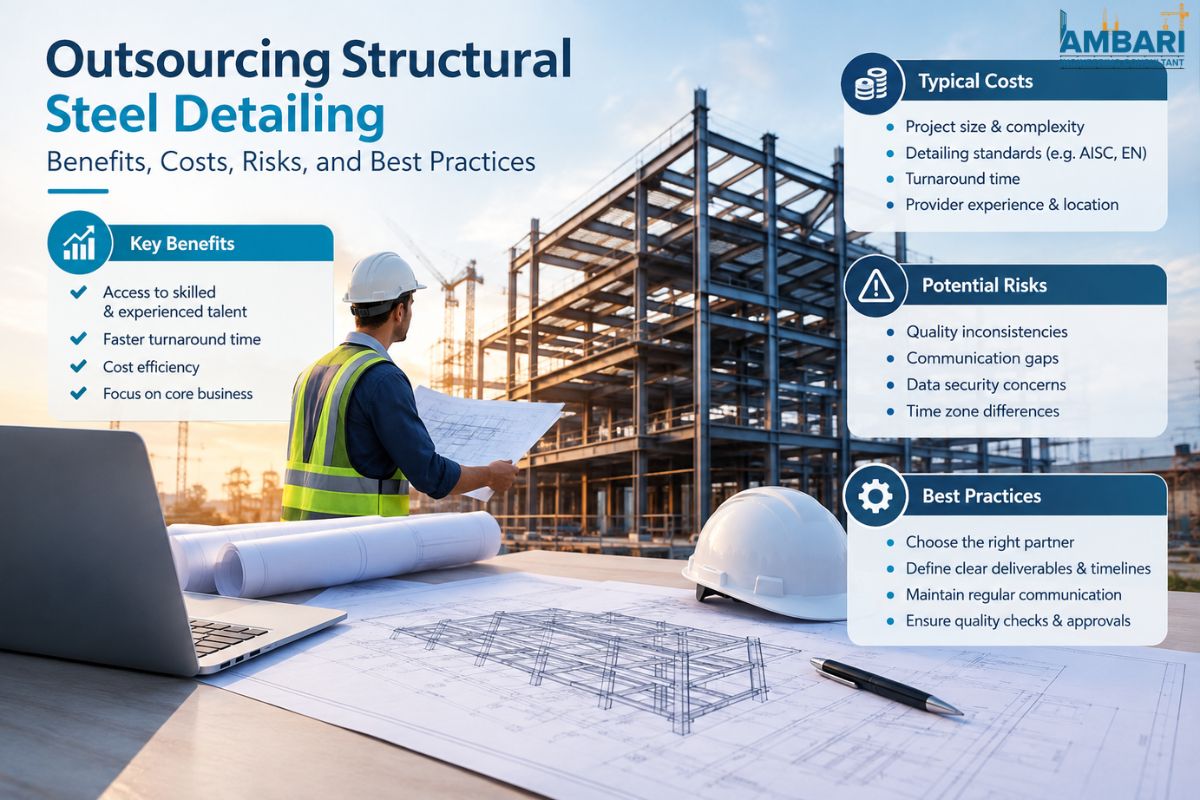
In the case of outsourcing structural steel detailing, one gives over the shop and erection drawings to a team outside of one's office so that the in-house team can continue with design work or project management. The practice is a success when the detailers are familiar with Australian fabrication practice, know about connection design responsibilities as per AS 4100, and do not have to guess about the local steel sections and bolts.
However, it fails if the project is simply tossed over in PDF format with a deadline and no further communication occurs until the due date of the drawings. Here is an overview of how the benefits, the associated costs, the risks, and the practices that lead to the avoidance of issues appear.
Key takeaways
- Using structural steel detailing services from outside Australia on a project can help speed up timelines considerably.
- Connection details are usually responsible for more rework compared to most general arrangement drawings.
- Rework due to revisions made to original designs and conflicts during the production stages of a project may cost more than the original structural detailing services.
- It is important to clearly outline the scope of work involved when carrying out structural modelling.
What structural steel detailing actually involves?
Detailing sits between engineering design and the shop floor. An engineer sizes the members, sets load paths and connection capacities, and lays out the general structure. The detailer's job is turning that into something a fabricator can cut, drill, weld, and put together: shop drawings for individual members, general arrangement drawings showing how it all fits, erection drawings for the crew on site.
It's more than redrawing the engineer's work. A detailer has to sort out:
- Exact hole positions, bolt gauges, and edge distances
- Weld sizes and profiles that actually match the specified connection capacity
- Cope and notch dimensions so members physically fit together
- Material lengths, accounting for mill tolerances and cutting allowances
- The bill of materials for procurement
Moreover, most of this now happens in 3D modelling rather than flat 2D drawings. The advantage isn't just neater drawings; it's that clashes get caught on screen instead of on site, where fixing them costs a lot more.
Benefits of outsourcing steel detailing
Firms outsource for different reasons, and the reason usually shapes whether it's the right move.
- Capacity during busy stretches: A fabricator running two large jobs at once often doesn't have enough detailers in-house to keep both moving without one slipping. Outsourcing steel detailing services in Australia lets a shop take on that extra volume without hiring someone they'd have to let go once the project wraps up.
- Specialist connection knowledge: Tanks, bridges, mining infrastructure- these need connection detailing that a generalist hasn't necessarily done before. Bringing in a firm that's detailed that structure type before saves the learning curve mid-project, which is exactly when you don't want a learning curve.
- Lower overhead for smaller shops: A shop doing residential or light commercial steel can't usually justify a full-time detailer on the books. Paying for structural steel detailing services Australia-wide, project by project, works out cheaper than carrying that salary through the quiet months too.
- Faster drawings: A team detailing full-time, without also fielding RFIs and site phone calls, tends to move through a model faster than an in-house detailer juggling three other things.
- Fewer clashes make it to the shop: Detailers who see a wide range of projects catch coordination problems, services clashing with steel, tolerances that don't stack up, earlier, mostly from having seen the same mistake before.
Therefore, there's a cost to this that's easy to gloss over: outsourcing means less day-to-day visibility into how the model is actually progressing. That gap doesn't fix itself. It needs a plan.
Costs: what you're actually paying for
Detailing in Australia is usually priced in one of three ways.
| Pricing model | How it works | Best suited to |
|---|---|---|
| Per tonne | Rate applied to estimated steel tonnage | Larger jobs with stable scope |
| Hourly | Billed on actual hours worked | Complex or evolving connection design |
| Lump sum | Fixed fee for defined scope | Smaller, well-documented projects |
Per-tonne rates swing a lot depending on how complex the connections are. A plain portal-frame shed detailed at volume costs a fraction, per tonne, of a structure loaded with heavy connections, staircases, and non-standard members. If someone quotes a flat per-tonne figure before asking about connection complexity, they probably haven't actually looked at your drawings yet.
The cost that catches people out is revisions. Three rounds of engineering changes, each billed separately, can push the final invoice well past the original quote. Ask upfront how many revision cycles are covered and what kicks in after that; it matters more to the final number than the headline rate for steel fabrication drawings services in Australia ever will.
The Hidden Cost of Rework
Rework is the other cost nobody puts on the quote:
- A clash missed in the model and caught on site can mean field cutting or re-drilling
- Sometimes a member has to go back to the shop entirely
- The schedule delay from that often costs more than the physical fix
None of this makes outsourcing expensive as a rule. It just means the lowest number on the page isn't always the cheapest project by the end.
Risks worth knowing before you sign a contract
Outsourcing has real risks, and it doesn't help anyone to pretend otherwise.
- Time zone gaps: An offshore detailer with limited overlap in working hours means a query can sit for a full day before anyone answers it. On a tight fabrication schedule, that's a day you don't have.
- Standards familiarity: A detailer trained on a different country's codes won't automatically apply AS 4100 or the AS/NZS 5131 construction categories correctly, not because they're careless, just because it's unfamiliar territory. Ask about this before the contract, not after the first drawing set comes back wrong.
- Model ownership: Some arrangements keep the 3D model sitting on the detailer's system, with limited rights to take it elsewhere. If the relationship ends mid-project, you can end up with PDFs and no usable model.
- Version control: When changes arrive by email, phone, and marked-up PDF all in the same week, something gets missed eventually, and a drawing goes out against an outdated design.
- Uneven quality across one team: Bigger outsourced firms split large jobs across several detailers. Without someone checking the whole model before issue, one section can be noticeably tighter than another.
Furthermore, these aren't arguments against outsourcing. They're the list of things to put in the contract before you sign it, not the list of things to discover halfway through.
Steel connection detailing: where most rework happens
Connections deserve more attention than the rest of the drawing set. A mistake on a general arrangement drawing is usually cheap to fix and easy to catch. A connection that doesn't match its specified capacity isn't a drafting mistake; it's a structural one.
Steel Connection Detailing Services in Australia usually cover:
- Moment and shear connections detailed to the capacities the engineer specified
- Base plate and anchor bolt layouts
- Bracing connections, gusset plate sizing included
- Splice connections for long members shipped and erected in sections
Getting this right takes an understanding of load transfer, not just geometry. A bolt group can look fine on the drawing and still be under-designed for the actual shear load, and that's not something you spot by eye. It needs checking against the connection design, by the engineer or by a detailer with delegated design authority under AS/NZS 5131.
Moreover, this is also where the case for outsourcing is strongest. Connection detailing is its own skill, separate from general drafting, and someone who's detailed hundreds of moment connections on multi-storey buildings will catch things a first-timer on a commercial job simply won't see yet.
Best practices for choosing and managing an outsourced partner
A few checks tend to separate a good partner from one that only looks good on paper.
- Ask for actual sample drawings, not a portfolio, from a job similar in scale and connection complexity to yours.
- Ask about their RFI process. Who answers a query: the detailer on the model or a coordinator relaying messages? The gap between those two answers matters.
- Ask which AS/NZS 5131 construction category they've worked to, and whether they're comfortable taking on delegated connection design if that's part of the job.
- Ask how they check their own work. One detailer reviewing their own drawings isn't quality assurance. A second set of eyes before the issue is.
- Get file handover in writing. The native model file, not just PDFs, with ownership transferring on payment.
- Agree revision limits before work starts, not after the third round of changes lands.
- Keep one point of contact for design changes. It's the simplest fix for the version-control problem above.
Ambari Consultant works with fabricators and engineering firms on a fair few of these connection-heavy jobs, and the pattern holds up: the projects that run smoothly are the ones where scope, revisions, and file ownership were nailed down before anyone opened the model.
Local factors that affect detailing in Australia
A handful of things about working in Australia change how this gets done compared to other markets.
Local steel sections follow Australian designations, and a detailer who isn't used to them loses time cross-referencing before drawing even starts. Bolt and weld standards under AS/NZS 5131 also differ from US or European codes, so a drawing set produced without that local grounding usually needs a full standards check before an Australian fabricator can actually use it.
Additionally, climate matters too. Structures on the coast in cyclone-prone areas, Queensland and parts of Western Australia especially, carry higher wind loads that feed straight into connection sizing. A detailer working off a generic template without checking the site's wind classification can undersize a connection that looks perfectly fine on the drawing.
Distance plays a role most people don't think about until it bites them. Fabrication shops and remote or remote-regional sites can be a long way apart in Australia, and member lengths and splice points often get set by what can actually be trucked and lifted at the destination, not by what would be structurally neatest.
Wrapping up
This isn't a decision that comes down to price on a spreadsheet. It comes down to whether the detailer knows Australian codes, handles connections properly, and tells you about changes instead of letting them slip through. When that's in place, structural steel detailing services Australia-wide can cut real time off a project and keep rework off the shop floor.
When it's not, the savings on the quote get eaten up fast by revision fees and field fixes. Sort out the benefits against the real costs and risks before you sign anything, and put the practices above in writing while there's still time to negotiate them.
Frequently asked questions
1. What's the difference between steel detailing and structural engineering?
Engineering decides what the structure needs to do and sizes the members for it. Detailing turns that into fabrication-ready drawings with exact dimensions, holes, and welds. A detailer doesn't change structural sizing without sign-off from the engineer.
2. How long does outsourced detailing usually take?
Depends on tonnage and how complex the connections are. A simple shed might be a one- to two-week job. A multi-storey building with heavy connection work can run for months, often alongside construction rather than finishing before it starts.
3. Can a small fabrication shop outsource just part of a project?
Yes, and plenty do. Connection detailing gets outsourced while general arrangement stays in-house, or overflow work goes out during a busy patch, and everything else stays put.
4. Why do quotes for the same job vary so much?
Detailers estimate connection complexity differently, and some quotes bake in more revision rounds than others. The lower number isn't automatically the cheaper project once you see what's excluded.
5. Is 3D modelling always necessary, or is 2D fine for a simple job?
For something genuinely simple, 2D still works. Once there's any real connection complexity or multiple trades to coordinate, 3D catches clashes early enough to matter, and most fabricators expect it by default now anyway.
6. What happens if the design changes mid-detailing?
A detailer who's built the model properly, with correct referencing from the start, can flag just the affected drawings and reissue those, rather than redoing the whole set from scratch.