.png)

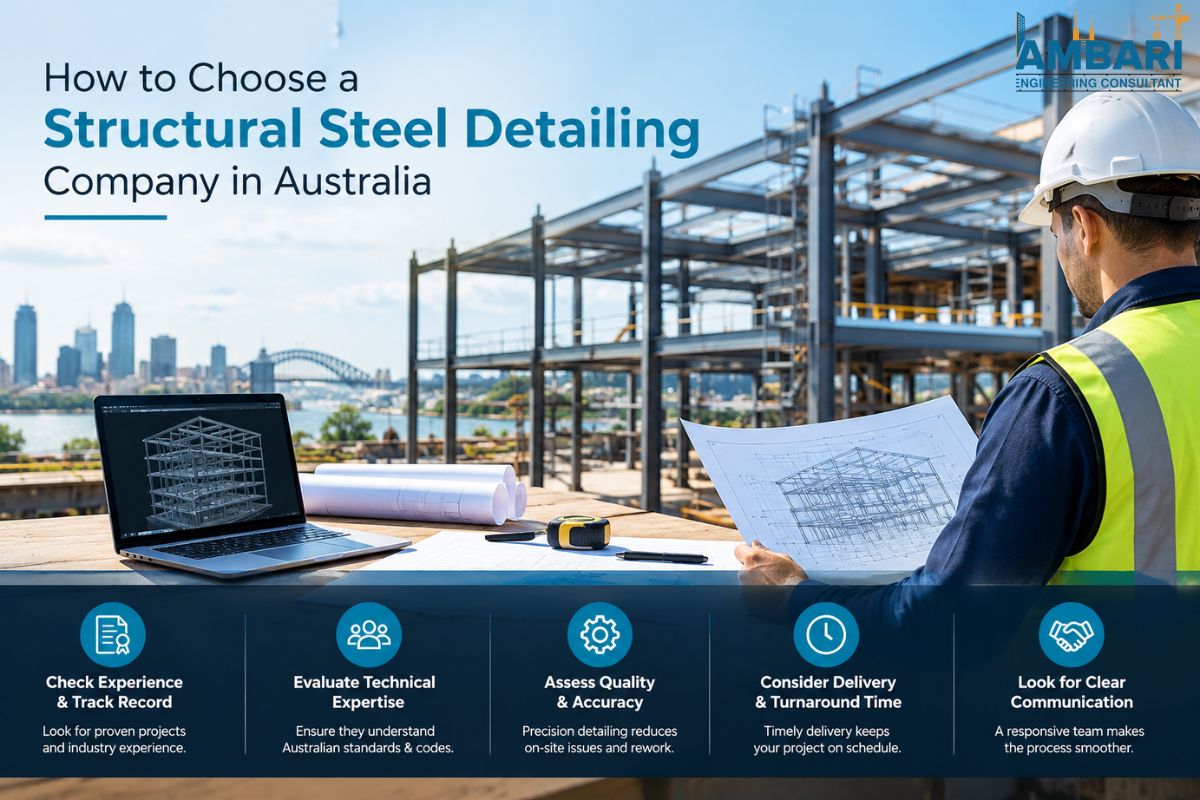
Shortlist companies with Australian project experience, then compare sample drawings, quality-control steps, revision handling, and communication habits. Ask who checks the drawings before issue, how clashes are caught, and how fast they respond to changes. Weigh the price after you are confident in their accuracy.
A good provider can show anonymised sample drawings, explain how they check their work, and describe a past problem they solved. Vague answers and generic brochures are a warning sign.
You can test the working relationship early. Send a realistic question about your project and see how quickly and clearly they reply. The response is a fair preview of the next six months.
Look for a company that has worked on Australian commercial, industrial or infrastructure projects. Local experience means they understand how Australian engineers, fabricators and builders expect drawings to be presented, reviewed and approved, which cuts down on queries once fabrication starts.
Experience depends on the type of work as well as the years in business. A detailer who has handled warehouses may not suit a complex multi-storey frame, and the reverse also holds.
Questions worth asking:
Additionally, teams that have seen the full chain, from the engineer's design intent through to erection on site, tend to deliver the structural steel detailing services Australia clients can trust.
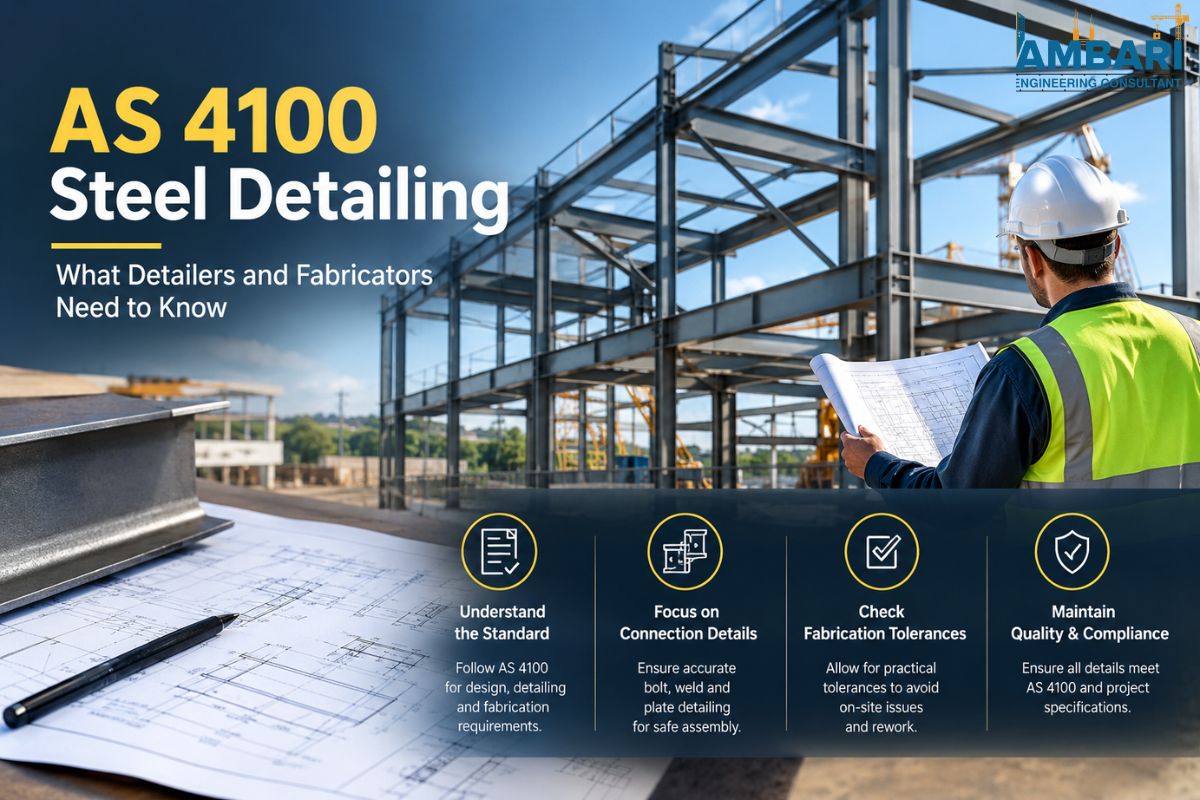
Australian standards shape how steel is designed, welded, bolted, fabricated and erected. A detailer who knows them produces drawings that match engineering intent and pass review faster, with fewer queries from fabricators and certifiers. Without that knowledge, corrections tend to surface late.
Detailing is more than drawing what the engineer sketched. It turns design information into buildable details that follow the rules the project must meet. Depending on the job, those rules commonly draw on standards such as AS 4100 for steel structures, AS/NZS 5131 for fabrication and erection, and AS/NZS 1554 for structural steel welding. The project specification and the engineer's documents confirm what applies to your job.
A detailer does not need to recite standards, only to work within them without prompting. Ask how they confirm which standards apply and how they handle a conflict between a specification and a drawing.
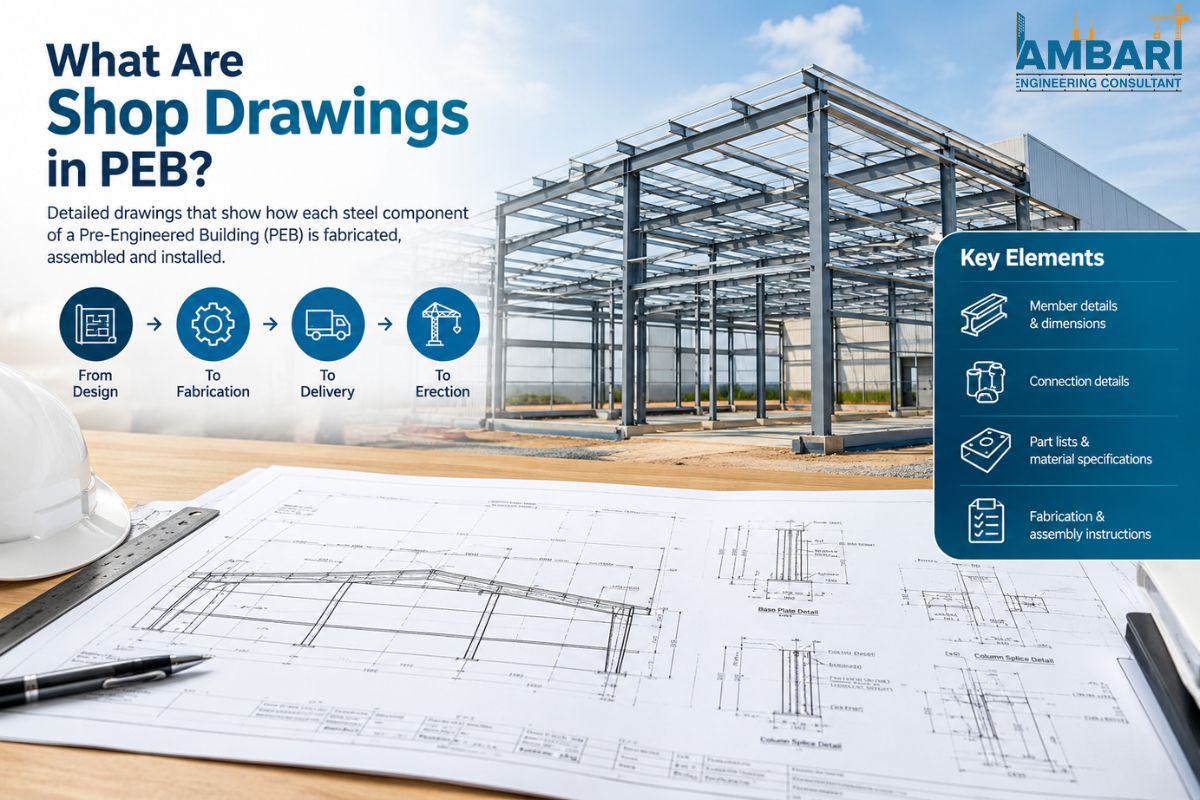
Good fabrication drawings show clear member sizes, grades, dimensions, hole positions, weld details, connection information, marks, and assembly views. A fabricator should be able to build from them without guessing or chasing the detailer for missing information. Gaps here slow the workshop.
Quality in steel fabrication drawings services in Australia varies more than most buyers expect. When you review a sample, check that:
Moreover, erection drawings matter just as much. They tell the site crew where each piece goes, in what order, and how it connects to its neighbours, and unclear ones show up as delays on site.
Connections hold the structure together, and they are where most fit-up problems start. Accurate connection detailing ensures bolts can be reached, welds can be done, clearances work, and loads follow the engineer's intent, all before steel leaves the workshop.
Members are simple in isolation. Connections are where the geometry gets tight. A beam that looks fine on its own may clash with a column flange, a bracing gusset or a neighbouring connection once real plate sizes are applied.
Steel Connection Detailing Services in Australia should include checks on bolt access, weld positions, edge distances and tolerances, with the result confirmed against the engineer's design information. The detailer should also flag connections that are hard to fabricate or erect and suggest alternatives for engineer approval.
A connection that cannot be assembled safely on site is a poor one, however well it works on paper.
A good detailing partner thinks about the shop floor and the site as well as the drawing sheet. Find out whether they consider fabrication sequence, material availability, transport limits, and crane access when they detail.
Practical support also means answering fabricator queries quickly. When a workshop supervisor needs clarification, a short, clear reply keeps production moving, while a slow one can stall a job for days.
For erection, look for clear piece marks, sensible splice locations and drawings that show the intended sequence where it matters. Small choices, like where a splice sits, can change how safely and quickly steel goes up.
Steel meets concrete, services, facades, and other trades. Good detailers build coordination into the process through 3D models and regular clash checks, so problems are found before steel is cut.
Communication matters as much as technical skill. You want a detailer who:
Poor communication causes more detailing trouble than poor drafting. When engineers, fabricators, and builders each get different information, mistakes follow.
Ask how the company checks its work. A trustworthy answer includes independent checking by someone other than the person who drew the sheet, model checks for clashes, and a review of connections and dimensions before issue.
Ask, too, what happens when an error is found after issue. A mature provider has a clear process for correcting, reissuing, and tracking drawings so everyone works from the current version.
If a company cannot describe its checking steps, treat that as a red flag.
A very short turnaround quote may signal rushed checking or a team stretched too thin.
Ask about current workload, team size, and how they handle peak periods. Check how they plan the drawing release so the fabricator can start on critical items first. A staged release often keeps a project moving better than waiting for one large package.
Furthermore, when you compare structural steel detailing services Australia-wide, put capacity and realistic programmes next to price. A cheaper quote that runs late can cost far more than a fair quote that arrives on time.
Designs change: architects update layouts, engineers revise members and builders adjust sequences. What matters is how your detailer handles it.
Look for clear revision control, with each drawing carrying a revision mark, a description of what changed, and a date. Ask how they communicate changes to the fabricator, so nobody builds from an outdated sheet.
Find out their approval workflow too: who reviews drawings, how long reviews usually take, and how comments are tracked. A tidy process keeps the project moving and heads off arguments later.
Detailing errors can lead to rework in the workshop, delays on site, extra crane time, remedial welding and strained relationships between trades. Small drawing mistakes often cost far more to fix after fabrication than before.
The cost of a mistake grows as it moves downstream. A dimension error caught during checking costs minutes. The same error found on site can mean cutting, welding, and re-fitting steel that is already in place.
Moreover, other costs are less visible: idle crews, rescheduled deliveries, and lost time for other trades waiting on the steel. These rarely appear in the detailing quote but often land on the project budget.
The following are realistic industry scenarios, not actual projects completed by Ambari Consultant.
Project situation: A multi-storey commercial building with steel framing around lift cores and service risers.
Problem: Several beam connections arrive on site and do not fit.
Detailing issue: Connection plates were drawn without checking clearances against neighbouring members and bracing.
How a competent company would handle it: They would run coordinated model checks, flag tight areas early, and propose adjusted connection geometry for engineer approval before fabrication.
Practical outcome: Fewer site modifications and a smoother erection sequence, with less friction between the builder and the fabricator.
Project situation: An industrial warehouse with a large portal frame and repeated bracing connections.
Problem: Erection crews struggle to reach bolts, and the sequence is unclear.
Detailing issue: Connections were detailed without considering bolt access or the order of assembly.
How a competent company would handle it: They would review constructability, adjust bolt orientations, mark splice positions sensibly and issue clear erection drawings showing the sequence.
Practical outcome: Faster, safer erection and less time spent on site solving avoidable problems.
Ask about relevant Australian project experience, standards knowledge, checking processes, revision control, coordination methods, turnaround capacity, and who your day-to-day contact will be. Good answers are specific and backed by examples.
Useful questions include:
Additionally, clear, practical replies suggest an experienced team, so listen to how each question is handled.
These mistakes come up repeatedly:
Most of these come from rushing the selection. A few days spent on careful comparison can save weeks later.
Ambari Consultant provides structural steel detailing support, including connection detailing, fabrication drawings and erection drawings. For teams that want a detailing partner focused on drawing clarity, coordination and practical constructability, it is a company worth including in your shortlist and testing against the questions above.
As with any provider, the sensible step is to request sample work, discuss your project scope and see how the team communicates before you commit.
Judge a detailing partner on accuracy, Australian industry knowledge, constructability, communication, quality control, fabrication readiness and project experience, rather than price alone. Review drawings, ask direct questions and test how a company responds.
If you are comparing structural steel detailing services Australia projects can rely on, Ambari Consultant is one option to assess alongside others, using the same practical checks.
1. How do I choose a steel detailing company in Australia?
Compare Australian project experience, sample drawings, quality checks, revision handling and communication. Choose the team that shows clear processes and answers your questions directly.
2. Why is Australian standards knowledge important?
Standards guide design, welding, fabrication, and erection. A detailer who understands them produces drawings that match engineering intent and need fewer corrections.
3. What is steel connection detailing?
It is the design of the physical details where steel members join, including plates, bolts, and welds, so they fit, can be built, and follow the engineer's intent.
4. What should fabrication drawings show?
Member sizes, grades, dimensions, holes, welds, marks and assembly information, clear enough for the workshop to build without guessing.
5. What quality checks should a detailer carry out?
Independent drawing checks, model clash checks, connection reviews and a clear process for correcting and reissuing drawings.
6. How does a detailer coordinate with other project teams?
Through shared models, regular clash checks, written queries and clear points of contact between engineers, fabricators and builders.
7. How are design revisions handled?
A good detailer tracks revisions, marks what changed, reissues only the affected drawings and tells the fabricator in writing.
8. How long does steel detailing usually take?
It depends on project size, complexity, and the quality of the information supplied. Ask for a realistic programme and a staged drawing release plan.