.png)

Structural Steel Detailing Standards in the USA: AISC Requirements Explained
Table of Contents
- Key takeaways
- What AISC standards actually cover?
- Why is AISC compliance optional?
- Core requirements for steel fabrication drawings
- Steel connection detailing under AISC
- Structural erection drawings and field coordination
- AISC 360 vs AISC 303: what each document governs
- Common mistakes in AISC-based detailing
- Choosing the right detailing partner
- Final verdict
- Frequently asked questions
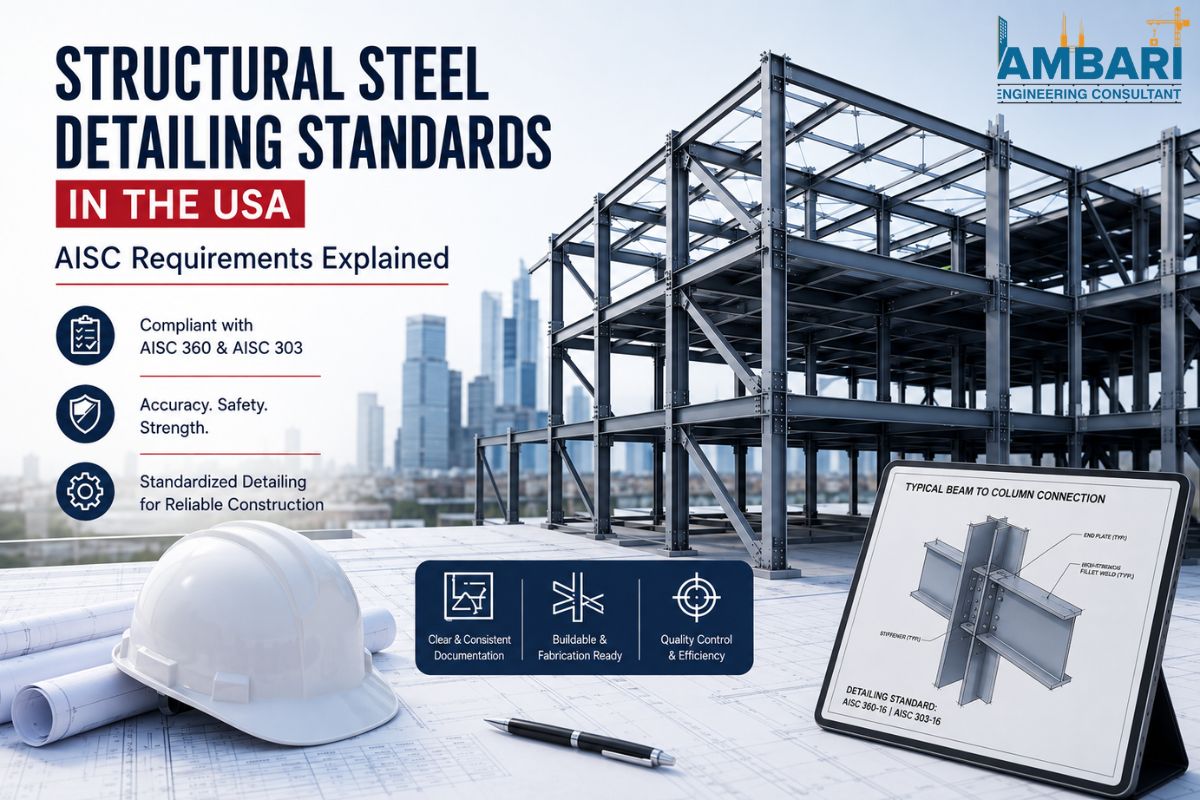
In the USA, structural steel detailing is mostly governed by two documents created by the American Institute of Steel Construction: AISC 360, the Specification for Structural Steel Buildings, and AISC 303, the Code of Standard Practice. They establish standards for how members are sized, how connections are designed, as well as tolerances and how the drawings should be produced and reviewed.
Any business that provides structural steel detailing needs to make their shop and erection drawings according to these two documents and additional rules of engineering specific for projects. The result of this will be clear in the form of requests for information, delays in fabrication, or rejected drawings. The sections below describe what the requirements for fabrication, connection, and erection drawings are and how people tend to make mistakes concerning these standards.
Key takeaways
- AISC 360 and AISC 303 are two important documents that provide guidance when it comes to deciding on important matters in the field of steel detailing in the United States.
- There is considerable risk involved in connection detailing due to possible misunderstandings of design obligations.
- Erection drawings often do not succeed as they disregard sequencing requirements in real-life projects.
- Excellent steel detailing teams know the limitations and possibilities of AISC and the specifications of a given project.
What AISC standards actually cover?
The American Institute of Steel Construction, which came into being in 1921, published its first structural specifications in 1923. Although this is not trivia information, it is important to remember. AISC has changed its specifications at an average rate of once every five years up to present, while the 2022 edition of its specifications (ANSI/AISC 360-22) is the one marking the centenary of the first document. Since today’s detailing teams use this century-old refinement, all deviations from it could lead to complications during permitting and inspecting processes.
AISC 360 covers engineering issues (allowable stresses, load combinations, LRFD and ASD methods, and connection strength), while AISC 303 (Code of Standard Practices) addresses issues of a process nature (documents needed in a set of structural design documents, and who approves what). Detailers have to deal with aspects of both these standards; if a shop drawing meets the requirements of AISC 360 but is in violation of rules aligned with AISC 303, it will be flagged.
Additionally, there’s also the RCSC Specification for Structural Joints Using High Strength Bolts, which is used together with AISC 360 when working with bolted connections. In the revision of 2022, the naming of bolt groups has been changed, wherein Group 120, Group 144, Group 150, and Group 200 are used rather than being referred to using letters A, B, C.
Why is AISC compliance optional?
Structural steel detailing services USA-wide aren't optional add-ons to a fabrication contract. Most state and municipal building departments reference AISC standards directly in their adopted codes, usually through the International Building Code, which points back to AISC 360 for steel design. A shop drawing package that doesn't demonstrate AISC compliance can stall at the permitting stage before a single beam gets cut.
However, there's a cost dimension too. Fabricators price jobs based on drawings they trust. If detailing has gaps, connection capacities that don't match the engineer's design, or tolerances that don't align with AISC 303, fabricators either build in contingency pricing or send the drawings back. Either way, the project loses time. I've seen jobs lose two to three weeks purely on RFI cycles caused by connection details that didn't specify bolt grade or weld size clearly enough to satisfy the reviewing engineer.
Core requirements for steel fabrication drawings
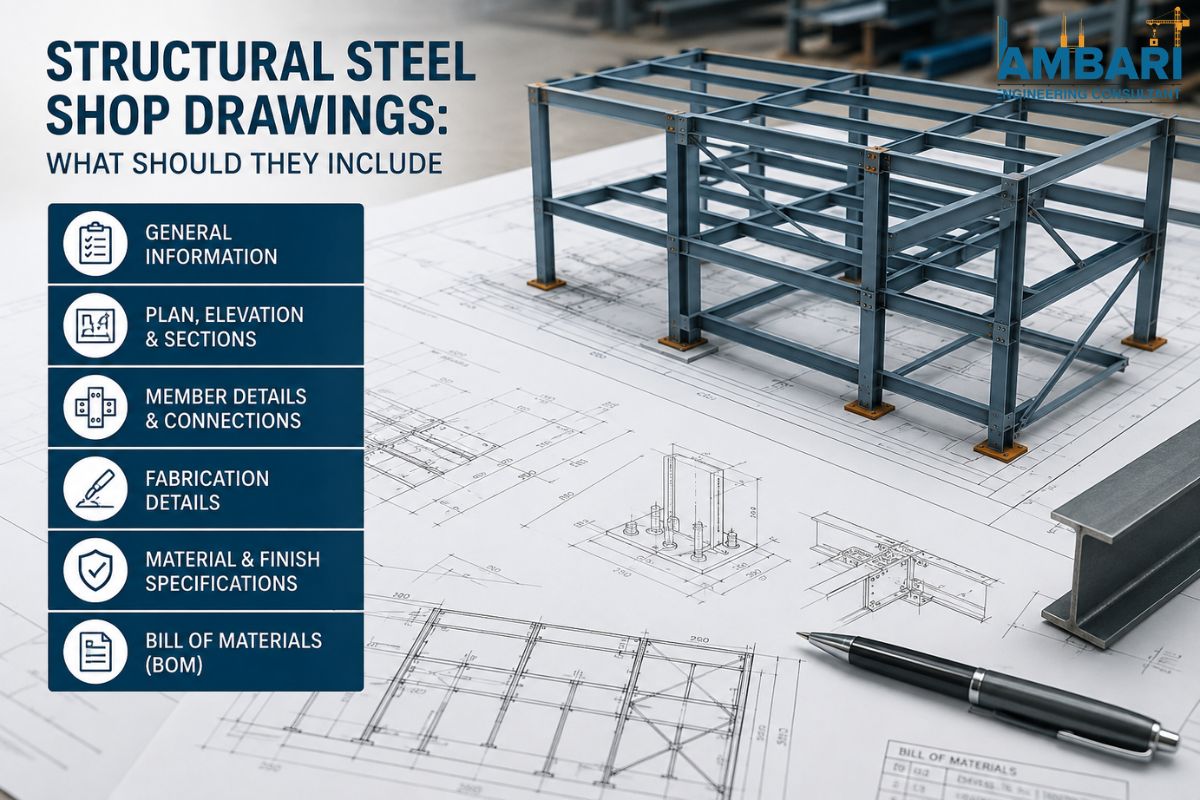
Fabrication drawings translate the structural engineer's design into instructions a shop can actually cut, drill, and weld from. Good steel fabrication drawings services in USA projects follow a consistent set of AISC-driven requirements:
- Member identification - matching the structural engineer's piece marks, with no renumbering that could create confusion on site
- Material grades - called out explicitly for every member, since AISC 360's design values depend on the specific steel grade used
- Connection details - showing bolt size, grade, quantity, and weld symbols per AWS D1.1, which AISC references for welding requirements
- Camber and cambering instructions - where beams require it, along with fabrication tolerances from AISC 303 Chapter 6
- Coating and finish notes - particularly for exposed steel or fireproofing interfaces
Therefore, one thing that gets missed often: AISC 303 requires that fabrication drawings show enough information for an independent reviewer to verify the connection design without needing the original calculations. That standard alone eliminates a lot of shorthand that detailers use out of habit.
Steel connection detailing under AISC
This is where most disputes happen. AISC 360 allows connections to be designed either by the engineer of record or, under a "simple shear connection" delegation, by the fabricator's engineer using the loads shown on the design drawings. Steel Connection Detailing Services in USA firms need to know exactly which category a given connection falls into, because getting it wrong shifts liability in ways that surface only after something goes wrong on site.
For moment connections, AISC 358 (Prequalified Connections for Special and Intermediate Steel Moment Frames) applies in seismic regions, and it's far more prescriptive than a standard shear tab. Detailers working on projects in high-seismic zones need familiarity with AISC 341 as well, since seismic provisions change bolt spacing, weld access hole geometry, and even which connection types are permitted at all.
A practical rule I follow: if a connection detail requires more than the loads shown on the drawing to design, it belongs with the engineer of record, not the fabricator's detailer. Treating every connection as delegable is a common shortcut, and it's the wrong one.
Structural erection drawings and field coordination
Erection drawings are where paper meets the actual job site, and they fail for different reasons than fabrication drawings do. Structural erection drawings services in USA teams need to account for erection sequence, temporary bracing, crane access, and bolt-up order, none of which show up directly in AISC 360 but all of which AISC 303 requires be considered as part of the erector's means and methods documentation.
Moreover, a recurring issue: erection drawings copied too closely from fabrication drawings, without adjusting for field conditions like staged deliveries or partial steel releases. AISC 303 places responsibility for erection stability on the erector, but the drawings a detailer produces are what the erection crew actually works from. If those drawings don't reflect real sequencing, temporary connections get skipped or improvised, which is exactly the kind of gap that shows up in incident reports.
AISC 360 vs AISC 303: what each document governs
| Aspect | AISC 360 (Specification) | AISC 303 (Code of Standard Practice) |
|---|---|---|
| Primary focus | Engineering design and member/connection strength | Process, documentation, and contractual responsibility |
| Governs | LRFD/ASD design methods, load combinations, connection capacity | Submittal content, approval process, tolerances |
| Who uses it most | Structural engineers, connection designers | Detailers, fabricators, erectors, general contractors |
| Latest edition | ANSI/AISC 360-22 | Referenced alongside 360-22, with its own update cycle |
| Typical detailing impact | Determines member sizes and connection capacities | Determines what drawings must contain and how they're approved |
Common mistakes in AISC-based detailing
- Treating AISC 303 as optional paperwork - It defines who's responsible for what, and skipping it creates scope disputes mid-project.
- Reusing old bolt group designations - Drawings still labeled Group A/B/C under the pre-2022 system can confuse fabricators using current material stock.
- Delegating connection design that shouldn't be delegated - Complex or seismic connections often require engineer-of-record involvement, not fabricator discretion.
- Skipping tolerance call-outs - AISC 303's fabrication and erection tolerances are specific values, not general guidance, and drawings that leave them implied invite field disputes.
- Under-detailing erection sequence - A geometrically correct erection drawing that ignores real-world sequencing still causes site delays.
Choosing the right detailing partner
The right partner for structural steel detailing services USA projects understands where AISC 360 ends and AISC 303 begins, and applies that distinction to every drawing set, rather than defaulting to whoever turns drawings around fastest. Firms like Ambari Consultant approach detailing this way, treating fabrication drawings, connection detailing, and erection sequencing as related but distinct disciplines.
When evaluating a partner offering Steel Connection Detailing Services in USA or steel fabrication drawings services in USA, ask specifically how they handle delegated connection design, how they track AISC revision changes across active projects, and whether their erection drawings get reviewed against actual site logistics before issue. Those answers tell you more than a portfolio of finished drawings ever will.
Final verdict
AISC standards run underneath the entire steel detailing discipline, from how a connection gets sized to what an erection crew sees on the drawings they're bolting from. Teams that approach structural steel detailing services USA-wide as AISC-literate work, and not just CAD output, are the ones that keep projects moving through permitting and fabrication without rework. Ambari Consultant builds fabrication and structural erection drawings services in USA projects around exactly this standard, keeping AISC 360 and AISC 303 requirements aligned from the first shop drawing to final erection sign-off. If your current detailing process is generating more RFIs than it should, that's usually the first place to look.
Frequently asked questions
- What's the difference between AISC 360 and AISC 303?
AISC 360 covers engineering design, member strength, and connection capacity. AISC 303 covers process: what drawings must include, approval steps, and fabrication and erection tolerances. - Is AISC compliance legally required in the US?
Most jurisdictions adopt AISC standards through the International Building Code, so compliance is effectively mandatory for permitting, even though AISC itself isn't a government body. - Who is responsible for connection design, the engineer or the detailer?
It depends on delegation. Simple shear connections can be delegated to the fabricator's engineer; complex or seismic connections typically stay with the engineer of record. - How often does AISC update its specifications?
Roughly every five years. The current edition, AISC 360-22, replaced the 2016 version and introduced several documentation and bolt-naming changes. - What is AISC 358 used for?
It governs prequalified moment connections in seismic steel frames, applying stricter geometry and detailing rules than standard shear connections. - Do erection drawings need engineering approval separate from fabrication drawings?
Not always separately, but they must reflect erection sequence and temporary bracing per AISC 303, which fabrication drawings alone don't address. - What causes most delays in AISC-based shop drawing review?
Missing tolerance call-outs, unclear connection capacities, and outdated bolt group nomenclature are the most common causes of RFIs and rejected submittals. - Can a detailing firm work across multiple AISC specification editions on legacy projects?
Yes, but it requires tracking which edition applies to each project, since older buildings under renovation may still reference AISC 360-16 requirements. - Does AISC certification apply to detailers directly?
AISC certification programs apply mainly to fabricators and erectors; the certification process itself typically takes eight to ten months to complete. - What should I look for in a structural steel detailing services USA provider?
Look for clear handling of delegated connection design, awareness of current AISC revisions, and erection drawings coordinated with actual field sequencing.