.png)

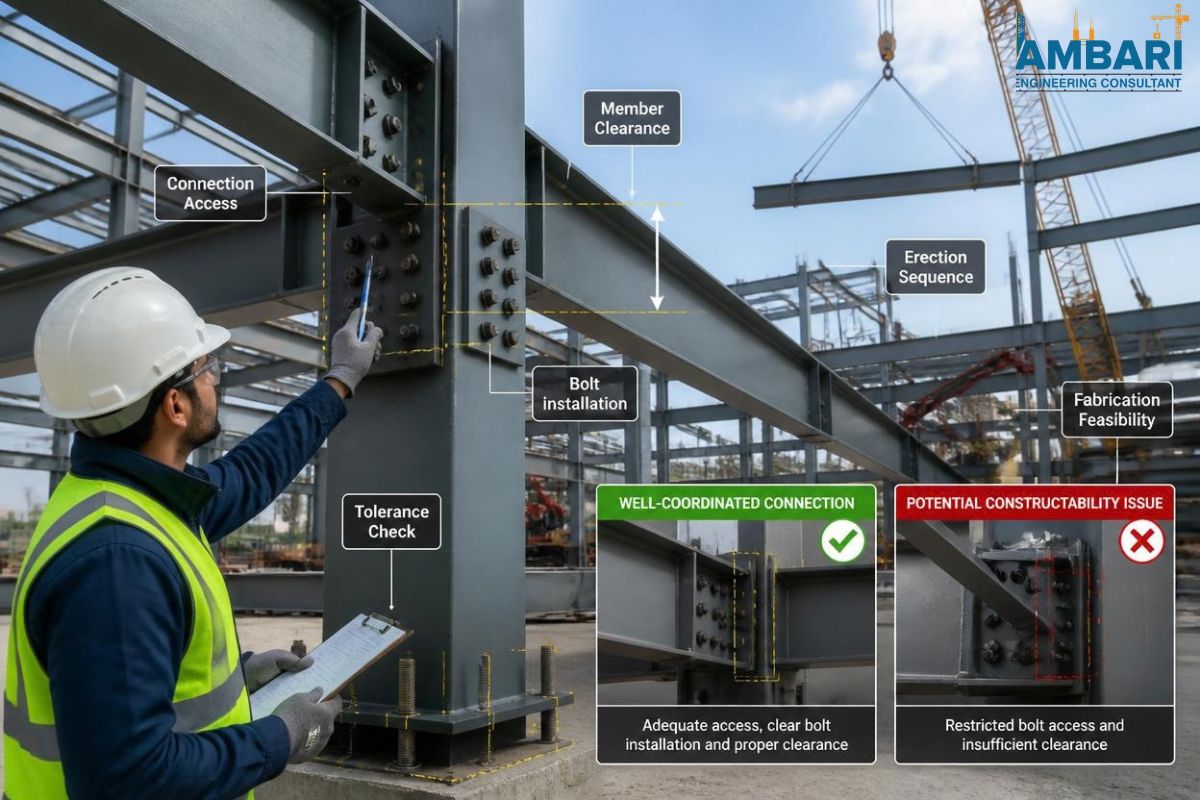
The concept of a constructability check is a systematic evaluation that ensures a steel structure is designed in a way that allows detailing, manufacturing, shipping, and assembling as required. In structural steel detailing, a constructability check helps identify clashes related to connections, bolt access, tolerances, as well as any conflicts before the issuance of shop drawings. Thus, this leads to a number of RFIs, minimal rework, and no delays at the site.
However, steel is relatively simple to change on paper but becomes very challenging and expensive to change at the shop or construction site. With a constructability check, a service provider brings field and shop knowledge into the detailing process at almost no cost. For construction companies that need structural steel detailing services in the USA, a proper constructability check allows them to quickly assess the level of quality control of the service provider.
A constructability review examines the design intent in relation to reality. Design drawings show geometry and loading, but do not commonly show the constraints of the shop equipment, the size of the trucks, crane reach, or wrench clearance.
During detailing, the detailer and the checker will inquire about four things:
If any of these questions result in a "no," then a notification will be sent. Structural questions are forwarded to the structural engineer, while the practical questions will be addressed by the detailer and the fabricator and erector.
However, specification review is a different activity than constructability review. It checks whether the documents are in agreement. Constructability review checks if it is possible to construct a physical structure based on the documents.
Each party carries a different risk, and a good check covers all of them.
| Perspective | Main concern | What the check protects |
|---|---|---|
| Engineer | Design intent and load path stay intact | Connections and member changes remain within the design basis |
| Fabricator | Efficient shop flow and clean material ordering | Fewer remakes, simpler fit-up, accurate material lists |
| Erector | Safe, fast, repeatable field installation | Bolt access, stable sequence, minimal field modification |
| Project manager | Schedule and budget certainty | Fewer RFIs, fewer change orders, fewer surprises |
Moreover, the engineer is focused on strength and serviceability; the fabricator is concerned with cutting, welding, drilling, and handling. The erector thinks about lifts, plumbing-up, and how to connect every aspect. The detailing process lies in the middle of these processes and can resolve the contradictions among them.
Connection checks confirm that each joint can be built the way it is shown. Reviewers look at:
Where connection design is delegated, the detailer also confirms that the information needed to design it is complete. Teams offering Steel Connection Detailing Services in the USA usually build this check straight into their workflow.
A size that works on paper may be hard to buy or fabricate. The check covers:
Bolt access causes more field trouble than almost anything else on this list. A bolt that a wrench or tensioning tool cannot reach cannot be installed properly. Reviewers check:
Weld checks balance what the design asks for against what the shop and field can actually do:
Splices affect cost, schedule, and safety. A good review looks at:
The shop needs drawings that match how it works. Checks include:
Therefore, clear fabrication drawings cut down on shop questions and mark-up cycles. That is why steel fabrication drawings services in USA are judged on checking quality as much as output speed.
A frame has to be stable at every stage of the build, not just when it is finished. Reviewers confirm:
Detailers who prepare structural erection drawings services in the USA depend on this check to make sure the plan on paper matches how a crew will really install the steel.
Real steel and real concrete never match their nominal dimensions exactly. Checks look at:
Clashes between steel and other trades are a leading cause of site rework. Checks cover:
| Area | Key question |
|---|---|
| Connections | Is every joint buildable as detailed? |
| Member sizes | Can the material be bought, shipped, and lifted? |
| Bolt access | Can tools physically reach every bolt? |
| Welds | Can the weld be made and inspected in position? |
| Splices | Do locations suit shipping and erection? |
| Fabrication | Can the shop produce it with standard methods? |
| Sequence | Is the frame stable at every stage? |
| Tolerances | Is there room for real-world variation? |
| Clashes | Does steel conflict with other trades? |
Problems in construction rarely get confined to the small level. What is a narrow clearance in the model becomes a hindrance in the shop, and then it results in a delay on site. The chart illustrates how every cost category reacts to a good checkup.
| Problem area | How it shows up without checks | How checks help |
|---|---|---|
| RFIs | Repeated questions on conflicts, missing dimensions, unclear details | Issues are resolved and documented before drawings are released |
| Rework | Cut-and-reweld, re-drilled holes, remade pieces | Problems are caught while still on screen |
| Fabrication errors | Wrong sizes, misaligned holes, connections that do not fit | Drawings match shop processes and material reality |
| Site delays | Crews waiting for answers or field fixes | Erection sequence and access are tested ahead of time |
| Unexpected costs | Change orders, overtime, extra crane time | Fewer late changes and fewer surprises |
Field fixes tend to be the most expensive kind. They happen under schedule pressure, with crews and cranes already on site. A check done during detailing keeps those decisions in the office, where they cost far less.
Constructability works best when it starts early and continues through detailing.
Later checks still help, but options narrow once steel is ordered and fabrication begins.
Constructability is a working practice that sits alongside the standards used for structural steel in the United States:
Furthermore, a detailer who knows these references can tell when a drawing detail conflicts with accepted practice or with erection safety needs.
If you are comparing providers of structural steel detailing services in the USA, ask how constructability fits into their process. Good signs include:
Ambari Consultant builds its workflow around these checks so that fabrication and erection packages reach the shop and the site in a form that can be built.
Constructability checks bring shop and field experience into detailing, where changes are quick and inexpensive. The payoff is clearer fabrication drawings, safer erection plans, fewer RFIs, less rework, and fewer budget surprises.
For engineers, fabricators, contractors, and project managers, the practical point is simple. Treat constructability as a required quality-control step in every steel detailing workflow, and make it part of how you choose structural steel detailing services USA. When the check is built in from the start, a project moves from model to shop to site with fewer interruptions.
It is a review that confirms steel can be detailed, fabricated, shipped, and erected as drawn. It focuses on practical issues such as bolt access, clearances, splices, tolerances, and clashes.
Mostly detailers and checkers, with input from the fabricator and erector. Anything structural goes to the engineer of record.
It is one part of it. Standard checks confirm that drawings are accurate and consistent. A constructability check confirms that an accurate drawing can actually be built, which is a different question.
As early as possible. The ideal start is a pre-detailing review, and the checks continue through modeling and up to drawing release.
They catch missing information, conflicts, and unclear details before drawings go out. Fewer open questions reach the fabricator and erector, so fewer turn into RFIs.
Blocked bolt access, tight clearances, clashes with other trades, poorly placed splices, and tolerance conflicts at concrete interfaces come up most often.
No. Detailers may suggest alternatives, but any change that affects design intent needs engineer approval. Structural questions always go back to the engineer.
Steel and concrete both vary from their nominal dimensions. If a detail has no room for that variation, fit-up in the field becomes difficult.
It helps confirm that members can be set stably and connected from safe positions. Sequence, lift weights, and access get reviewed before the crew arrives.
Ask who performs the checks and when they happen. Then ask how RFIs and clashes are tracked, and how issues reach the engineer, fabricator, and erector.