.png)

Key takeaways
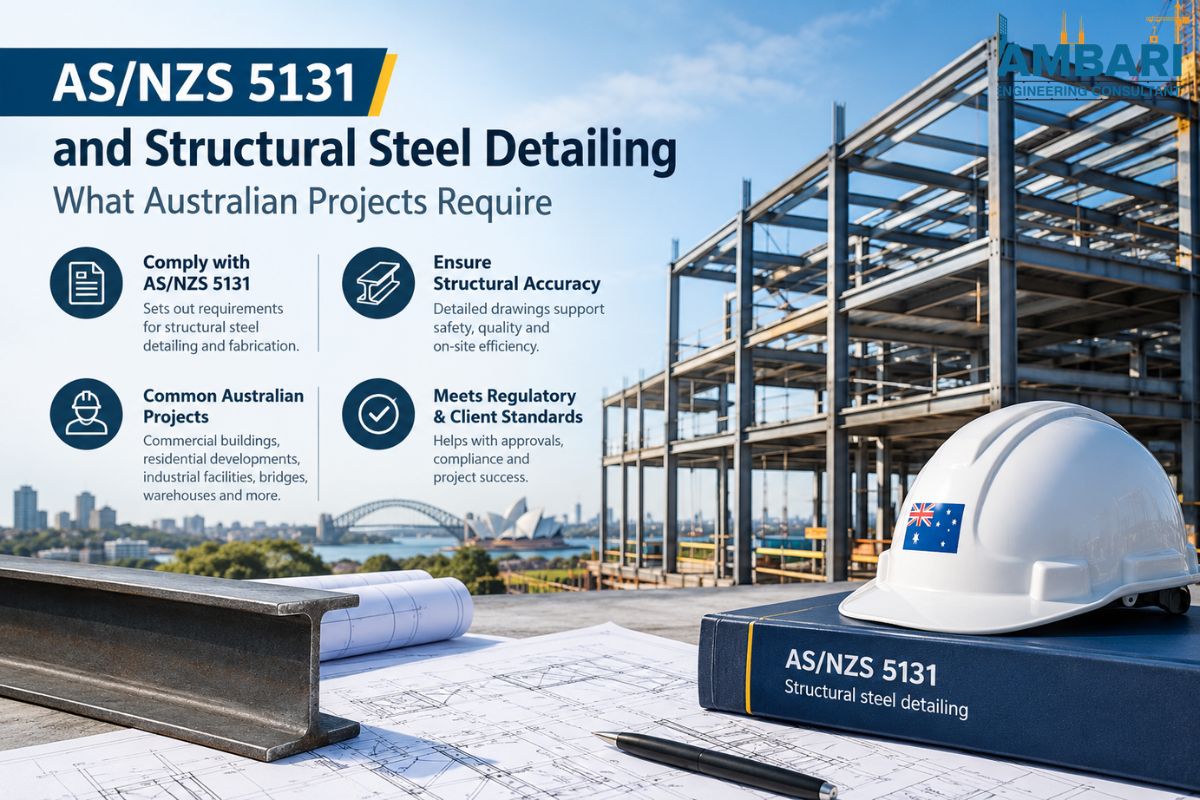
- AS/NZS 5131 provides certain categories for construction which dictate the level of detail on drawings and requirements for inspection and documentation.
- In Australia, the design process involves ensuring compliance with certain checks in the drawings for both shop fabrication and erection.
- It is very important to mention welding processes and bolt torque in construction drawings.
- Qualified AS/NZS 5131 experts will help to minimize RFIs, fabrication mistakes, and delays in the erection process.
What is AS/NZS 5131?
AS/NZS 5131:2016 governs structural steelwork fabrication and erection in Australia and New Zealand. Before it existed, practice varied a fair bit between states, and detailers often worked off whatever reference the engineer happened to prefer. The standard replaced that with one category-based framework tied to the consequence of failure.
Structures fall into four Construction Categories, CC1 to CC4. A backyard shed and a hospital carry very different risks if something goes wrong, and the standard scales documentation, inspection, and welding requirements to match. A CC1 project might need little more than standard fabrication drawings. A CC4 project needs a paper trail that would make a compliance officer happy.
Therefore, for anyone commissioning structural steel detailing services Australia-wide, the category usually gets set by the structural engineer early in design. Everything downstream- the fabrication drawings, the weld symbols, the erection sequence- follows from that one decision.
Why does this standard matter for steel detailing?
Detailing sits between what the engineer intended and what actually gets cut, welded, and bolted together. Before AS/NZS 5131, detailers often had limited guidance on inspection levels or welding procedure documentation, and gaps in that documentation tended to surface at the worst possible time, during certification or partway through erection.
However, the standard requires fabrication documentation to carry specific, traceable information tied to the Construction Category. A small agricultural shed under CC1 needs relatively light paperwork. A stadium roof or a building with public assembly space under CC3 or CC4 needs detailed weld procedure specifications, non-destructive testing records, and a proper inspection and test plan.
That's forcing steel detailing services in Australia to change how they work. Drawings now need to reference the applicable category, spell out weld types and inspection levels clearly, and line up with the project's Inspection and Test Plan from the start, not patched in once fabrication has already begun.
Construction categories explained
Here's what the four categories actually mean in practice.
| Category | Typical Structures | Detailing Requirements |
|---|---|---|
| CC1 | Low-rise sheds, minor structures | Basic fabrication drawings, standard weld symbols |
| CC2 | Warehouses, low-rise commercial buildings | Weld procedure references, moderate QA documentation |
| CC3 | Multi-storey buildings, bridges | Full WPS documentation, defined NDT levels, traceability |
| CC4 | High-consequence structures (stadiums, hospitals) | Comprehensive ITP, third-party inspection, full material traceability |
Furthermore, a detailer doesn't get to pick the category. The structural engineer assigns it based on consequence of failure, occupancy, and risk classification under the wider Australian Standards framework. From there, the detailer's job is to turn that category into drawings a fabricator and an erector can follow without having to guess.
What compliant detailing actually involves?
Producing accurate dimensions and connection details was never really the hard part. A few things have become standard practice for any project above CC1.
Weld procedure alignment matters more than most people expect. Every weld on a fabrication drawing needs to trace back to an approved Welding Procedure Specification, and the detailer needs to know beforehand which procedures the fabricator is actually qualified for.
Material traceability comes into play for CC3 and CC4 work. Steel fabrication drawings services in Australia typically need to include heat numbers or material certificates linking each member back to its mill certification.
Inspection and test planning has to show up in the drawings themselves, flagging hold points, witness points, and NDT requirements so the ITP and the shop drawings actually agree with each other.
Erection sequencing has grown more detailed too. Structural erection drawings services in Australia increasingly need to show temporary bracing, lifting points, and sequence numbering, not just final member positions, especially on CC3 and CC4 jobs where certifiers look closely at erection stability.
Moreover, get these right at the detailing stage, and it saves a lot of grief later. Certifiers and building surveyors will ask for this documentation no matter how far along construction is, so there's no real upside to leaving it for later.
Common compliance mistakes on site
The same handful of problems keep showing up on Australian projects when detailing and compliance aren't aligned early enough.
- Detailers start drawing before confirming the Construction Category with the structural engineer.
- Weld symbols on shop drawings don't match the fabricator's actual qualified WPS range.
- Material traceability records for CC3 and CC4 members are missing or incomplete, and nobody notices until final inspection.
- Erection drawings leave out temporary bracing or lifting sequences, which stalls the site while engineers scramble to issue clarifications.
- Compliance gets treated as the fabricator's problem alone, rather than something built into the detailing process from the start.
Most of this is avoidable with early coordination between the engineer, detailer, and fabricator, ideally before shop drawings are locked in rather than after the RFIs start piling up.
Choosing the right detailing partner
Given how much of AS/NZS 5131 compliance rides on accurate, category-aware documentation, who you choose to do the detailing matters more than it might seem. A few questions worth asking before engaging structural steel detailing services Australia-wide:
- Do they routinely work across CC1 to CC4, or mostly on simpler structures?
- Do their drawings reference specific WPS numbers and inspection levels, or just generic weld symbols?
- Do they check with fabricators about qualified welding procedures before finalising drawings?
- Can they produce erection sequencing that accounts for temporary stability and lifting?
Ambari Consultant works across PEB and structural steel detailing projects in India, Australia, and the US, and that kind of exposure to different markets tends to help when Australian compliance demands tight coordination between design intent and what's actually achievable on the fabrication floor. A partner who already understands category-based documentation cuts down the back-and-forth that otherwise slows things down at certification. Structural erection drawings services in Australia can be helpful.
Cost and timeline considerations
Detailing costs track the Construction Category, so it's worth setting expectations early rather than being surprised halfway through.
CC1 and CC2 projects generally see standard turnaround, since the documentation load is lighter. CC3 and CC4 projects take longer because WPS cross-referencing, traceability documentation, and ITP coordination all add time compared with a simpler structure.
Additionally, budget for that upfront. Don't assume detailing costs will look like they did on a previous, lower-category job. Engineers and builders who flag the Construction Category early, and pass it on to their detailing provider before drawings start, tend to avoid the scope creep that comes from fixing compliance gaps midway through.
Wrapping up
AS/NZS 5131 has pushed structural steel detailing services Australia-wide to build compliance into the drawings from day one, rather than treating it as something to sort out before handover. Understanding the Construction Categories, getting weld procedures aligned early, and picking a detailing partner with real cross-project experience are what usually separate a clean certification from a delayed one. If your next project needs detailing that accounts for this from the outset, it's worth having the Construction Category conversation with your detailing provider before the drawings start.
Frequently asked questions
- What is AS/NZS 5131 in simple terms?
It's the joint Australian and New Zealand standard for structural steelwork fabrication and erection, setting documentation, welding, and inspection requirements based on a structure's Construction Category and consequence of failure. - Who decides the Construction Category for a project?
The structural engineer assigns it during design, based on occupancy, consequence of failure, and risk classification, and that decision guides all the detailing and fabrication documentation that follows. - Does AS/NZS 5131 apply to small residential steel structures?
Small, low-risk structures usually fall under CC1, which carries lighter documentation requirements, but the standard still applies, so basic fabrication drawings and standard weld symbols are expected. - Why do fabrication drawings need to reference welding procedures?
Because inspectors and certifiers check that the welds shown on drawings match approved WPS documents the fabricator actually holds, which confirms the specified weld quality is achievable and traceable. - What happens if detailing doesn't account for Construction Category?
Projects tend to hit RFIs, rework, or delays at certification when drawings lack the traceability, inspection references, or WPS alignment the category requires. - How does erection sequencing relate to compliance?
Structural erection drawings services in Australia need to show temporary bracing and lifting sequences for higher categories, since erection stability is a documented part of compliance rather than a judgment call made on site. - Can one detailing provider handle both fabrication and erection drawings?
Yes, and many steel fabrication drawing services in Australia handle both, which usually keeps shop and site documentation more consistent than splitting the work between two providers. - How early should the Construction Category be confirmed with a detailer?
Before shop drawings begin, ideally, since it affects weld specifications, traceability requirements, and inspection planning from the first drawing revision.