.png)

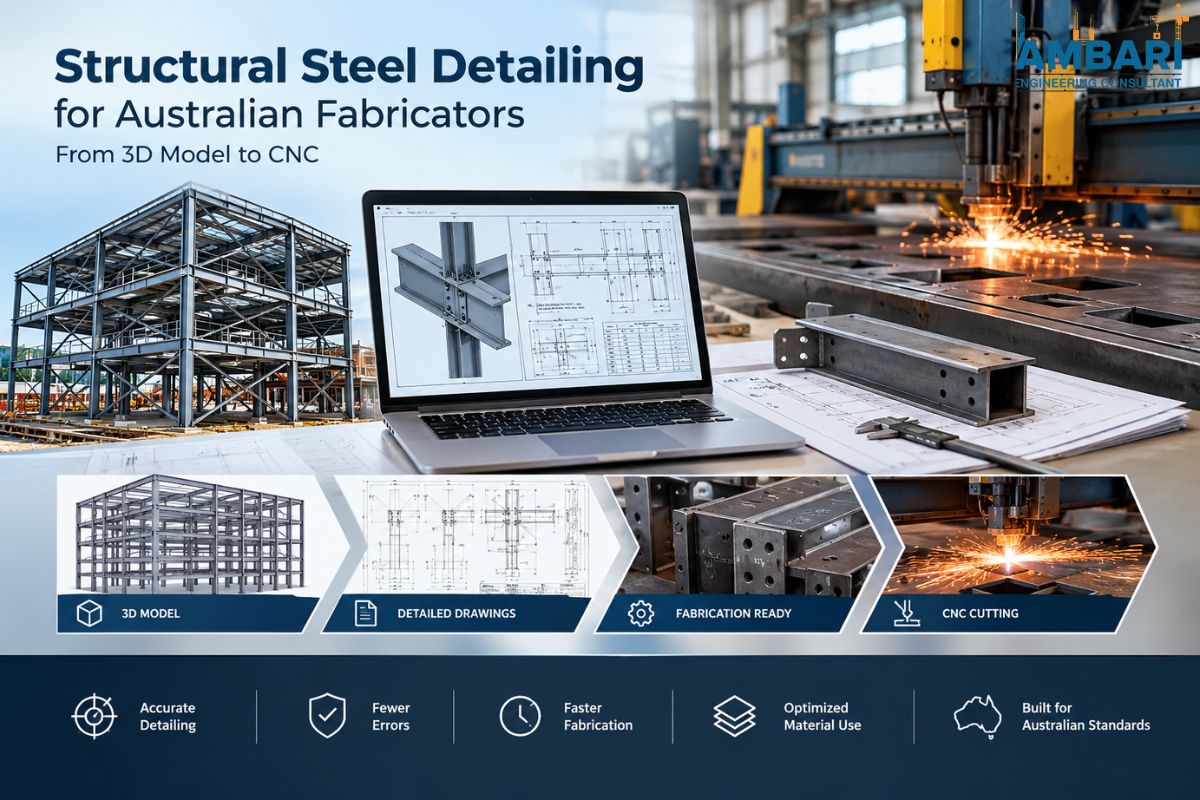
Structural Steel Detailing for Australian Fabricators: From 3D Model to CNC
Structural steel detailing is the process of converting an engineer's design into accurate drawings and data that the fabricator can cut, drill, weld, and assemble. Structural steel detailing services in Australia are responsible for taking the 3D model, adding all connections, plates, bolts, and welds, and then feeding clean information to CNC machines.
This blog takes you through that process step by step, demonstrates the drawings that Australian fabricators use, and how to prevent mistakes from slowing you down. In every small workshop and big fabrication yard, accurate detailing is the one which saves time, material and costly rework.
Key takeaways
- Structural steel detailing converts engineering designs into drawings and CNC data for fabrication.
- The 3D model, the stage before the machine export, is critical to every stage, and the machine export is critical to the stage after.
- Shop and erection drawings are two distinct types and require certain scrutiny.
- Costly rework on site is avoided due to early review, clash checking, and clear communication.
What is structural steel detailing and why does it matter?
Structural Steel Detailing is the phase that takes engineering design drawings into a form that is suitable for fabrication. It displays member sizes, cut lengths, connection geometry, bolt layouts, and weld requirements in detail. By providing accurate detailing, fabricators can work without guesswork, minimize clashes on site, and ensure projects are completed on time.
Structures are designed to be strong, stable and safe. They give beam sizes, column sections, load paths, but not necessarily all the plate thicknesses, hole locations or weld lengths. That is the space that detailers occupy. Their task is to ensure that the design is conveyed into information that meets Australian standards such as AS 4100, the construction and use of steel structures, and AS/NZS 5131, the fabrication and erection of steel structures.
A complete detailing package typically covers:
- Steel sizes, grades and cut lengths.
- All end plates, cleats and gusset plates
- Bolt specifications, sizes, hole diameter, and tightening specifications.
- Weld symbols, weld size and weld length.
- Place pieces, assembly sequences and erection references
Why is this important? A small mistake in a detail can have a domino effect on a project. If the hole is two millimetres off, a bolt cannot be inserted into it. Without a weld symbol, a welder is left with no choice but to guess. That is where good detailing comes in and provides the shop floor with a clear route from drawing to finished member.
How does the detailing workflow move from 3D model to CNC?
There is a logical flow from model to machine. The procedure is cumulative, and once a mistake is made, it is likely to be repeated at the end. The following steps are common in most projects:
- Get engineering design and approved drawings for review.
- Construct a correct 3-D model of each member and plate.
- Describe connections, bolts, welds, and holes.
- Create fabrication and erection drawings for review.
- The part is being exported for use in CNC cutting and drilling or punching machines.
- Confirm nesting, marking, and final quality before release.
Review the design package first and see if it is complete. The majority of early delays are due to missing dimensions, conflicting levels, and unclear load notes. Experienced detailers ask questions prior to modelling, not assuming anything which could be incorrect.
Building an Accurate 3D Model
The 3D model is the basis of all the work. All beams, columns, braces and plates are installed to the design coordinates. Teams model at true size, ensure correct Australian section profiles (universal beams, universal columns, parallel flange channels, hollow sections) and ensure correct alignment of grids and levels. There are no problems identified until they clash with steel, concrete and building services.
Therefore, a good model will also mark material grades, finishes and surface treatments. If this information is kept consistent from the beginning, it will make it much easier to verify and trust each and every step thereafter, from drawing to machine data.
Detailing Connections and Members
Connections should be given the most consideration. They should be stamped with a detail, such as an end plate, a web cleat, a gusset plate, a stiffener, or a splice. Detailers select the size and grade of bolts to be used, determine edge and spacing distances, and specify weld type and weld length in a clear manner, so that a welder can work without having to ask questions.
Savory detailers will also ensure that the tools can physically access each and every bolt and weld at the end of the job. This small check saves you time and money on site changes, something that is much more difficult to remedy after a change in your drawing.
Preparing Data for CNC Machines
The information then goes to the shop floor, once the model and drawings are approved. Machines require precision cut lengths, hole coordinates, bevel angles, and part identifiers. Drawings are not read; data is read. Hence, the export stage should be treated with the same care as the drawing stage.
Machines typically need the following information for each part:
- The part profile and steel grade.
- It is simultaneously cut and end-prepared.
- The number and size of holes.
- Use of marking and piece mark numbers.
Each physical piece is accurately marked, in the drawing and in its record, to connect it to its drawing and record. Every number needs to be checked for clean data, to avoid mismatched parts and further reduce scrap.
Which drawings do Australian fabricators need?
Fabricators use a set of drawings, and the type is a key factor. The steel fabrication drawing services in Australia are used to create a comprehensive set of drawings for both the workshop production and site assembly of many projects. There are two principal types of shop drawings: erection drawings, and they each have their own specific application.
Shop Fabrication Drawings
The workshop is directed by shop drawings. They display every member, plate, and connection in detail, including dimensions, weld symbols, bolt information, and piece marks. Bill of materials lists are also included with strong shop fabrication drawing services in Australia, meaning that purchasing and production teams operate on a single source of truth.
Erection Drawings
Erection drawings are all about the site assembly. They indicate building layout, member positions, levels, the number of bolts to be tightened, and the lifting sequence. A good steel structure erection drawing service in Australia ensures that the site crews are working within the design intent and cranes are working efficiently throughout the site.
The table below shows the main types of drawings:
| Drawing Type | Main Purpose | Primary Users | Key Content |
|---|---|---|---|
| Shop fabrication drawings | Guide cutting, drilling, and welding | Workshop and CNC teams | Member details, connections, weld symbols, piece marks |
| Erection drawings | Guide site assembly | Erection crews and site supervisors | Layout, levels, member positions, lifting sequence |
| General arrangement drawings | Show the overall structure | Engineers and builders | Grids, elevations and key levels |
Why choose specialist detailing support?
There are a number of fabricators that may be able to draw their own drawings; however, specialist help provides focused experience. Teams working with steel on a regular basis will know which connections work easily and which require further care and attention, and where common mistakes may occur. When you work with a dedicated shop fabrication drawing services in Australia professionals can leave your engineers free to quote and produce.
Specialist support typically delivers:
- Quicker turnaround of drawing revisions.
- Improved detailing standards throughout the project(s).
- Less rework and material waste
- Skilled detailers when busy
From the first model to CNC-ready data, Ambari Consultant's mission is to concentrate on drawings that can be used on the shop floor without follow-up questions. That attention aids fabricators in safeguarding their schedules and margins.
Common mistakes that delay fabrication projects
Even the pros make mistakes. Most of them are from a lack of information or a lack of time. Having a list of common pitfalls makes sure you don't encounter them in the workshop.
- Drawing from superseded drawings or out-of-date design revisions
- No weld symbols and unclear weld lengths
- Bolt holes in the clash of services, cleats, or adjacent members
- There were errors in the size of the sections entered into the model.
- Poor coordination between detailers and fabricators.
The errors listed above tend to manifest late, when it's already time to get it on with erection and costs for correcting errors are highest. These are numerous issues that can be discovered through a careful study of each steel structure erection drawing service in Australia package before release. Always use a checklist, do clash checks, and verify the latest revision with the engineer before anything goes to the shop.
How can you choose the right detailing partner?
One of the most crucial choices for your project is finding the right provider. Effective structural steel detailing services Australia businesses are both knowledgeable and communicative, with a proven ability to deliver their work on time. Refer to the points below to make your comparisons.
- Expertise in Australian standards AS 4100 and AS/NZS 5131
- An unambiguous model review to final data release process
- Project history similar to that of industrial buildings or bridges.
- Responsive communication and quick handling of queries.
- Documented checks and revision control
Compare in-house and outsourced options before deciding:
| Factor | In-House Detailing | Specialist Detailing Partner |
|---|---|---|
| Staffing | Requires hiring and training | Access to experienced detailers |
| Peak workloads | Can cause delays | Capacity can scale with demand |
| Standards consistency | Depends on team experience | Standardised review processes |
| Overhead cost | Fixed salaries and software-free setup costs | Pay per project or scope |
Before making any commitment, always solicit sample drawings. Review the presence of clear connections, handling of piece marks, and the accuracy of the bill of materials in relation to drawings. A good partner will respond to these questions.
Closing line
Structural steel detailing is the link between designing and manufacturing. Cloud-based, from an accurate 3D model to clean CNC data, every step ensures quality, timing, and budget. If you are looking for steel fabrication drawings services in Australia or a steel detailing partner, make sure to consider clear processes, careful checking, and experience.
At Ambari Consultant, teams can assist fabricators with complex designs to transform them into drawings that seamlessly make the transition from screen to shop floor.
Frequently asked questions
1. What does a structural steel detailer do?
A detailer translates engineering drawings into accurate fabrication and erection drawings, such as connections, bolts, welds and piece marks.
2. How long does steel detailing usually take?
The size of the project and revisions determine the timing. Small jobs can take days to complete, and large projects can take weeks.
3. Which Australian standards apply to steel detailing?
AS 4100 (steel structures) and AS/NZS 5131 (fabrication and erection) are key references.
4. Can detailing be outsourced safely?
Yes, if the provider carries out clear checks and makes regular communications and revisions to checks based on those controls. Ask for samples before you buy.